
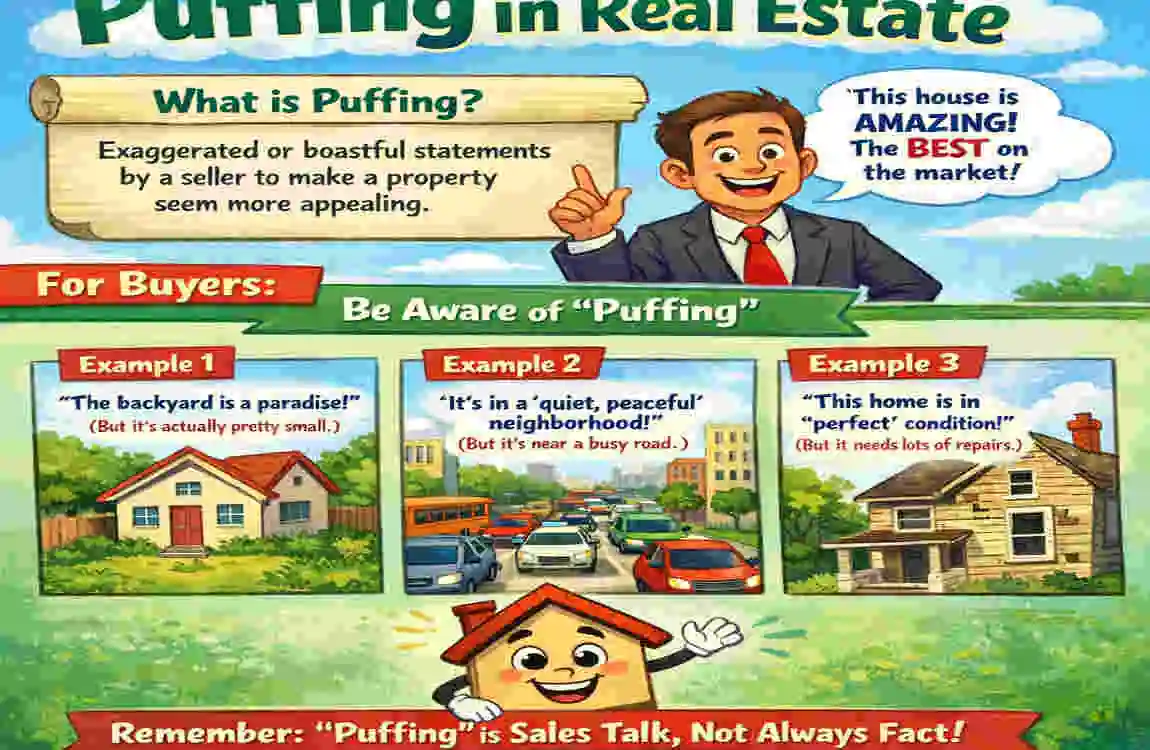
If you want to define puffing in real estate in simple terms, it means sales talk meant to sound exciting but isn’t a concrete fact. It is the kind of language sellers and agents use to make a property sound more appealing.
For example, when someone says, “This is the best house in the neighbourhood,” they are sharing an opinion, not a measurable fact. That is the key idea behind puffing.
People use puffing in real estate because buying a home is emotional. Buyers don’t want only numbers and square footage. They also want a feeling. So marketing language often tries to create that feeling.
Common Examples of Puffing in Real Estate

Everyday examples you may hear
You will often hear puffing in property ads, listing descriptions, and even casual conversations with agents. Common examples include:
- “This is the best house in the neighbourhood.”
- “You won’t find a better deal at this price.”
- “This home has amazing views.”
- “This is a dream location.”
- “One of the most desirable areas in town.”
These phrases sound strong, but they are usually just opinions.
Where puffing shows up
Puffing appears in many places:
- Property listings
- Open house speeches
- Advertising flyers
- Social media posts
- Negotiation talks
The goal is simple: make the property stand out.
How to spot exaggerated language
When you hear very positive words that feel emotional but not specific, you are probably hearing puffing. If the seller says the home is “charming,” “stunning,” or “one-of-a-kind,” that may be sales language rather than proof.
That does not always mean something is wrong. It just means you shouldn’t treat the statement as a verified fact.
Puffing vs Misrepresentation in Real Estate
What is misrepresentation?
Misrepresentation is different from puffing. It happens when someone makes a false or misleading factual statement that a buyer may rely on.
For example, saying a house has 2,000 square feet when it actually has 1,500 square feet is not puffing. That is a factual claim, and if it is false, it can cause real problems.
Why the difference matters
This is where many buyers get confused. Puffing is usually opinion-based. Misrepresentation is fact-based.
Here is a simple comparison:
StatementTypeWhy
“This is the best home on the block” Puffing Subjective opinion
“The roof was replaced last year” Fact Can be checked
“This house has a great layout” Puffing Personal judgment
“The lot is 10,000 square feet” Fact Measurable claim
“This home has never had water damage” Fact Must be accurate
When puffing becomes risky
Puffing becomes a problem when it starts to sound like a fact. A statement may seem harmless at first, but if it leads a buyer to believe something false, it can cross the line.
For example:
- “Amazing rental income” may be puffing if it is vague.
- “This property earns $3,500 per month in rent” is a specific claim and should be accurate.
The more exact the statement, the more care it needs.
Important areas to verify
Buyers should check facts about:
- Property size
- Age of the building
- Renovations
- Condition
- Zoning
- Rental income
- Nearby amenities
Do not rely only on a sales pitch for these details.
Is Puffing Legal in Real Estate?

The general idea
In many cases, puffing is allowed because it is considered opinion, not a hard fact. Real estate marketing often includes colourful language, and that alone is usually not illegal.
But the legal answer can depend on the statement, the situation, and local law.
Why context matters
A phrase that sounds harmless in one situation may cause trouble in another. If a seller says, “This is the safest neighbourhood around,” that may be treated as opinion. If they say, “There has never been any crime here,” that may be a factual claim that should be verified.
When legal issues may arise
Legal problems can happen if someone:
- Lies about a property fact
- Hides important information
- Makes misleading claims on purpose
- Breaks disclosure rules
- Gives information that a buyer relies on and that turns out false
So while puffing itself may be legal, false statements are a different matter.
Buyer protection matters
If you are buying a home, don’t rely only on promotional language. Review disclosures, inspect the property, and ask for proof when something sounds important.
If a dispute comes up, a qualified local real estate professional or attorney can help you understand your rights under the law.
How Buyers Can Identify Puffing
Watch the tone
A big clue is the tone of the statement. Puffing often sounds:
- Emotional
- Overly positive
- Vague
- Hard to prove
If the words feel more like marketing than information, slow down and look closer.
Ask for evidence
When a claim matters, ask for support. For example, if someone says the kitchen was recently remodelled, ask for receipts, permits, or photos.
If you can verify a statement, do so.
Check records and disclosures.
Always compare what you hear with:
- Public records
- Inspection reports
- Seller disclosures
- Comparable property sales
- Written contract details
This helps you separate opinion from fact.
Simple buyer checklist
Use this quick check when something sounds too good:
- Is it opinion or fact?
- Can I verify it?
- Is there written proof?
- Does it match official records?
- Should I ask a professional?
That small habit can save you a lot of trouble later.
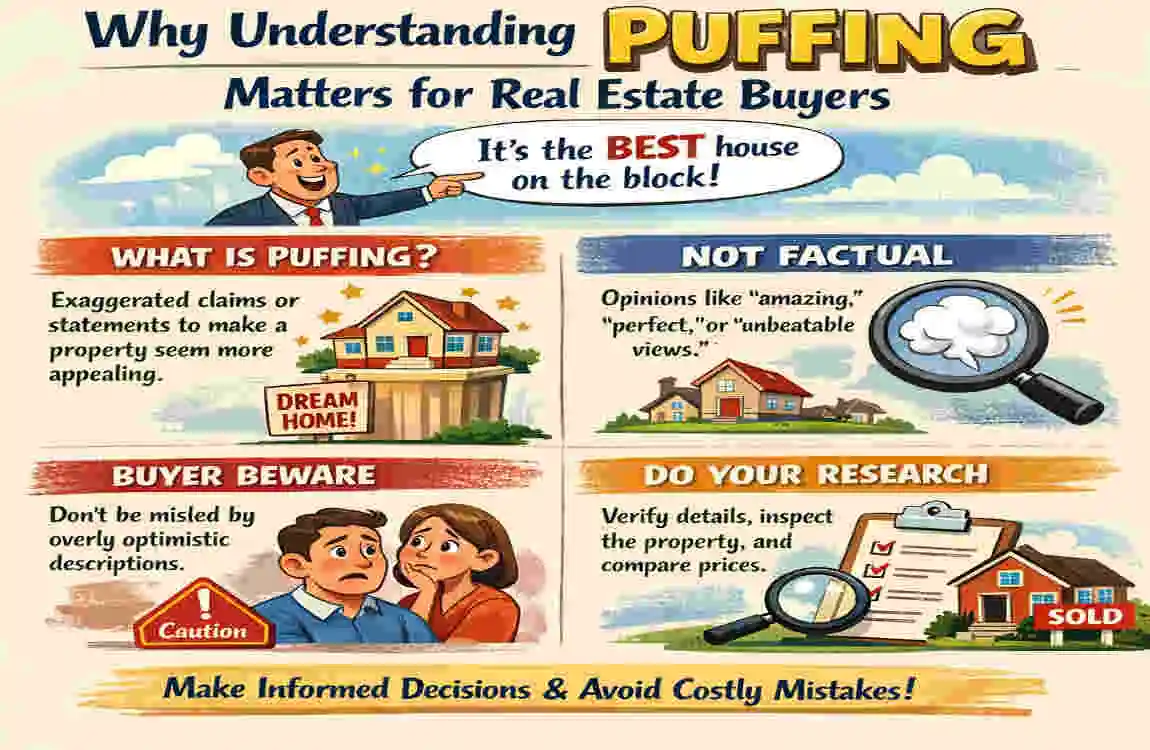
Why Understanding Puffing Matters for Real Estate Buyers
It affects your decisions.
Real estate is emotional, and that is exactly why puffing matters. Strong marketing can make a house seem better than it really is. If you are not careful, you may pay more attention to the words than to the property’s actual condition.
It helps you stay objective.
When you understand puffing, you can make calmer decisions. You start asking better questions and looking at evidence instead of just excitement.
That is especially important for first-time buyers, who may be hearing these phrases for the first time.
It protects you in negotiations.
If you know the difference between puffing and fact, you are in a stronger position during negotiations. You can push back on vague claims and focus on details that actually matter.
A practical example
Imagine an agent says, “This home is a dream for families.” That may be puffing.
But if the same agent says, “This home has a new roof, updated electrical work, and a larger lot than nearby homes,” those are statements you should verify.
The first one creates emotion. The second one gives you facts. You need both, but you should trust the facts more.
FAQ About Puffing in Real Estate
What does puffing mean in real estate?
It means promotional or opinion-based language used to make a home sound more attractive. It is not the same as a factual claim.
Is puffing the same as lying in real estate?
No. Puffing is usually opinion. Lying means intentionally giving false factual information. Those are not the same.
Is puffing legal when selling a house?
Often, yes, because opinions are usually allowed. But legal treatment can depend on the exact statement and the laws in your area.
What is an example of puffing in real estate?
A simple example is calling a property “the best home in the area” or “a dream location.”
What is the difference between puffing and misrepresentation?
Puffing is a subjective opinion. Misrepresentation is a false or misleading factual statement that can be checked.
| Term | Easy Explanation |
|---|---|
| Puffing | A seller or agent uses enthusiastic, subjective language to make a property sound more attractive. |
| Example | “This is the most beautiful home in the neighborhood.” |
| Main Purpose | To create interest and highlight a property’s appealing features. |
| Is It Usually a Fact? | No. Puffing is generally an opinion rather than a specific factual claim. |
| Puffing vs. Misrepresentation | Puffing is usually an opinion; misrepresentation involves presenting false or misleading facts. |
| Buyer Tip | Verify important claims such as size, condition, price, permits, and property features independently. |
