
If you are asking what FAR in real estate development is, you are already thinking like a smart planner. FAR, or Floor Area Ratio, is one of the most important numbers in property development. It helps you understand how much building space you can create on a piece of land.
This matters because land is limited, but the need to build is not. Developers, architects, investors, and property owners all use FAR to judge what is possible on a site. A small plot with a high FAR may support a much larger building than you expect. A large plot with a low FAR may allow only a modest structure.
FAR rules affect building size, density, land use, and project value. They also shape the way cities grow. That is why FAR is not just a technical term. It is a practical planning tool that can influence a project’s success from the start.
What Is FAR in Real Estate Development?
Simple Definition of FAR
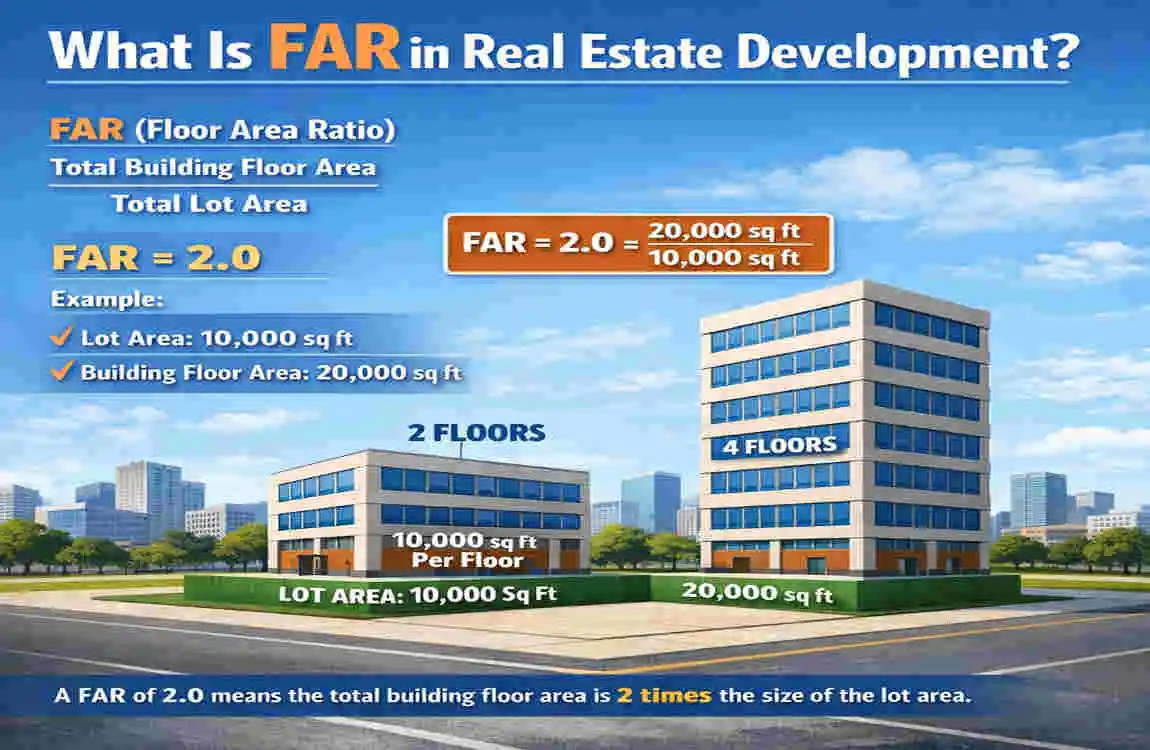
FAR means Floor Area Ratio. It is the relationship between a building‘s total floor area and the size of the land plot it sits on.
In simple words, FAR tells you how much building space you can have compared to your land area. If the FAR is low, the building must stay smaller. If the FAR is higher, you may be allowed more floor space.
Why FAR Exists
FAR is used in planning because cities need balance. Without rules, one building could take up too much space and overwhelm the neighborhood.
So local authorities use FAR to control density, protect infrastructure, and guide development in a structured way. It helps keep roads, light, air, parking, and public services manageable.
FAR vs Other Planning Terms
It is easy to confuse FAR with other terms, so let us separate them clearly.
- FAR measures total floor space against land size.
- Building coverage measures how much of the plot the building footprint covers.
- Height limits control how tall a structure can be.
- Zoning density may include the number of units or people allowed on a site.
These are related, but they are not the same. A project may still be limited by height, setbacks, or parking rules even if FAR is available.
Who Should Care About FAR?
You should care about FAR if you are a:
- Developer
- Property owner
- Architect
- Investor
- Builder
- Real estate buyer
Why? Because FAR affects what you can build, what it may cost, and how much value the land may hold.
How to Calculate FAR and Understand Its Limits
The Basic FAR Formula
The formula is simple:
FAR = Total floor area of the building ÷ Total plot area
For example, if a plot is 2,000 square feet and the FAR is 2.0, the total allowed floor area is 4,000 square feet.
That does not always mean one huge building on the ground. It could mean two floors of 2,000 square feet each, or four floors of 1,000 square feet each, depending on the design and local rules.
Simple Example of FAR Calculation
Let us say you own a 2,000 sq. ft. plot, and the zoning rules allow an FAR of 1.5.
You multiply:
2,000 × 1.5 = 3,000 sq. ft.
That means you can build a total of 3,000 square feet.
If you use two floors, each floor might be around 1,500 square feet. If you use three floors, each floor could be about 1,000 square feet. The exact design depends on setbacks, height rules, and other local limits.
How FAR Changes Usable Space
A higher FAR usually means more usable floor area. That can help if you want more living space, office space, or rental income.
But more floor area does not always mean better value. Sometimes a large building brings higher costs, more complexity, and more rules to follow.
Do All Spaces Count the Same?
Not always. This is where local regulations matter a lot.
Some areas may count basements, balconies, parking zones, or mechanical rooms differently. Some parts may be partly excluded from FAR calculations. Other parts may count fully.
Because of that, never assume all floor space is treated the same. Always check the local code.
FAR Table With Simple Examples
Plot Area FAR Maximum Floor Area
2,000 sq. ft. 1.0 2,000 sq. ft.
2,000 sq. ft. 1.5 3,000 sq. ft.
2,000 sq. ft. 2.0 4,000 sq. ft.
2,000 sq. ft. 3.0 6,000 sq. ft.
These are simplified examples. Actual permitted floor area depends on local FAR definitions, exclusions, and other development restrictions.
How FAR Rules Affect Building Design and Property Value

FAR and Building Design
FAR directly affects design. It changes how large the building can be, how many floors you can use, and how much open space remains on the site.
If FAR is low, you may need to keep the building smaller and more spread out. If FAR is higher, you may be able to build upward and create more space.
FAR and Height Limits
Many people think FAR alone determines building size. That is not true. You may still face height restrictions.
For example, even if the FAR allows more floor area, the building may not be able to rise above a certain number of stories. This is common in neighborhoods with strict planning rules.
FAR and Setbacks
Setbacks also matter. A setback is the required distance between the building and the plot edge.
Even if your FAR allows more space, you may still need to leave room around the structure for light, air, access, and safety. That can change the final design.
FAR and Property Value
FAR often affects property value because it changes development potential. More buildable floor area can make land more attractive to buyers and investors.
However, a higher FAR does not automatically mean a higher profit. Construction costs may rise. Approval processes may take longer. Market demand may also limit how much value the extra space creates.
FAR and Different Project Types
Low-Rise Projects
Low-rise projects usually use less of the available FAR. They may focus on privacy, open space, and a lower building profile.
This can work well for homes or small communities.
Mid-Rise Projects
Mid-rise buildings often use FAR more fully. They can balance usable floor space with reasonable height and site coverage.
These projects are common in mixed residential or commercial areas.
High-Density Projects
High-density developments often rely heavily on FAR. They maximize floor area on a limited plot.
These projects can be profitable, but they also require careful planning for traffic, parking, services, and open space.
FAR and Sustainable Growth
FAR is also a tool for managing city growth. When used well, it can prevent overcrowding and help cities expand in a controlled way.
It supports better planning for roads, utilities, sunlight, ventilation, and public spaces. That is why urban planners take it seriously.
FAR Regulations, Common Challenges, and Smart Planning Strategies

FAR Rules Can Change by Location
FAR is not the same everywhere. It can differ from one city to another, one neighborhood to another, or even one street to another.
That is why two plots of equal size may have very different building potential. The local zoning district often decides the actual limits.
Common FAR Challenges
Property owners and developers often run into problems when they assume the rules are simpler than they really are.
Some common issues include:
- Misreading zoning maps
- Confusing FAR with lot coverage
- Ignoring height limits
- Forgetting parking and fire rules
- Assuming all floor area counts equally
These mistakes can waste time and money, so it’s worth avoiding them.
Other Rules Can Limit Development Too
Even when FAR is available, other regulations may still prevent you from using the land to its full potential. These include:
- Setback requirements
- Parking space rules
- Fire safety codes
- Ventilation rules
- Height restrictions
- Open space requirements
So always look at the full rule set, not just the FAR number.
Smart Planning Strategies
To use FAR efficiently, plan early. Work with the right professionals and check the rules before you commit to a site.
A smart approach usually includes:
- Reviewing local zoning maps
- Talking to planning authorities
- Working with architects and engineers
- Checking survey reports
- Confirming what counts in the FAR calculation
Can FAR Be Increased?
In some places, yes. But it depends on the local system.
Some cities allow additional FAR through special approvals, incentive programs, or land transfers. In other places, the limit is fixed. Always verify this before planning a project.
Why Investors Should Care
Investors use FAR to assess a plot’s development potential. A site with useful FAR rules may support better returns. A site with low FAR may have more limited upside.
That is why FAR is often one of the first things serious buyers check.
Frequently Asked Questions About FAR in Real Estate Development
What is FAR in real estate development?
FAR, or Floor Area Ratio, is the ratio of a building’s total floor area to the plot’s land area.
What does a FAR of 2.0 mean?
A FAR of 2.0 usually means the total floor area can be twice the plot area, subject to local rules.
How is FAR calculated for a property?
Use this formula:
Total floor area ÷ Plot area = FAR
Or reverse it:
Plot area × FAR = Maximum floor area
Does a higher FAR increase property value?
Often, yes, because it may allow more buildable space. But value also depends on costs, demand, and market conditions.
Is FAR the same as building coverage?
No. FAR measures total floor space, while building coverage measures how much land the building footprint occupies.
Can developers increase FAR on their property?
Sometimes. This depends on local planning rules, special approvals, or development incentives.
Does FAR include basements, balconies, and parking areas?
That depends on the local code. Some areas include them, some include them partially, and some exclude them.
Why are FAR rules important for real estate investors?
Because FAR helps investors estimate what can be built, how much space may be developed, and whether a project is financially realistic.
| Topic | Short Information |
|---|---|
| What Is FAR? | Floor Area Ratio (FAR) measures the total permitted floor area of a building compared with the plot area. |
| FAR Formula | FAR = Total Floor Area ÷ Plot Area |
| Example | A 1,000 sq. ft. plot with a FAR of 2.0 allows 2,000 sq. ft. of total floor area, subject to local rules. |
| Why FAR Matters | It helps control building density, height, and land use. |
| Building Planning | FAR helps architects plan floor layouts and use available space efficiently. |
| Local Regulations | Permitted FAR varies by location, zoning, road width, and applicable building regulations. |
| Benefits | Better space planning, organized development, and more efficient land use. |
| Common Mistake | Assuming FAR determines building height or footprint by itself; other rules also apply. |
| Smart Building Tip | Check local zoning rules before designing or starting construction. |
| Conclusion | Understanding FAR helps property owners and architects plan smarter and avoid compliance issues. |
