
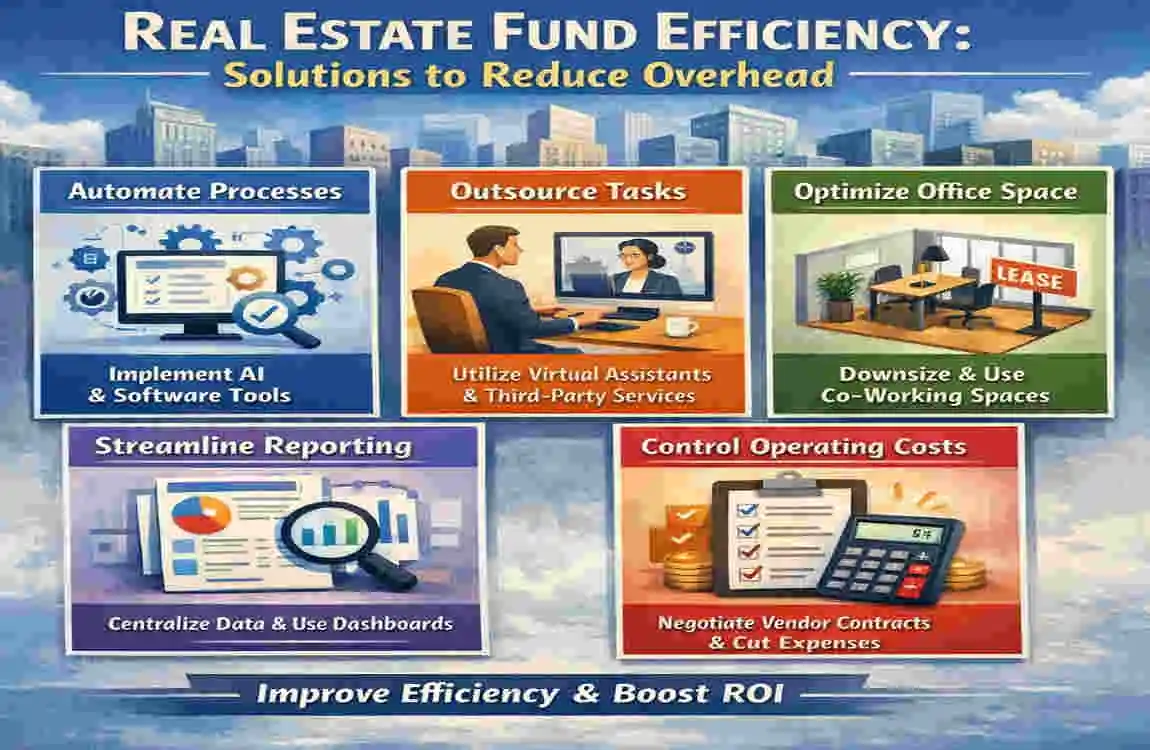
Real estate funds can grow fast, but so can their costs. As operations grow, overhead can quietly creep up. A few extra tools, repeated tasks, and service fees may not look like much at first. Over time, though, they can reduce fund efficiency and eat into returns.
That is why solutions to reduce overhead in real estate fund management matter so much. When you control costs well, you free up more money for performance, growth, and better investor outcomes. You also make the fund easier to run, scale, and monitor.
Real Estate Fund Management Overhead: What It Means

What overhead means in simple terms
Overhead is the cost of running the fund itself. It includes the money spent on people, tools, systems, services, and daily operations that keep everything moving.
Some of these costs are necessary. Others are avoidable. The goal is not to cut everything. The goal is to remove waste and improve efficiency.
Common sources of overhead
Real estate fund overhead often comes from:
- Administrative work
- Accounting and reporting
- Property management support
- Legal and compliance services
- Software and technology subscriptions
- Staffing and outside vendors
Each one may seem reasonable on its own. The problem appears when costs overlap, repeat, or grow without clear control.
Necessary costs vs. avoidable expenses
Not every cost is bad. Some expenses are important for compliance, reporting, investor trust, and smooth property operations.
Avoidable expenses are different. These include duplicate software, manual work that could be automated, and third-party services that do not add enough value. Separating the two makes it easier to protect the right spending and reduce the wrong spending.
Why overhead matters as funds grow
A small fund may survive with a simple setup. But as the fund adds more properties, investors, and reporting needs, overhead can rise quickly.
If you do not manage it well, growth can become expensive. That is why overhead control is not just a finance issue. It is a scaling issue too.
Key Causes of High Overhead in Real Estate Funds
Administrative and accounting expenses
A large part of overhead comes from daily admin work. This includes invoice handling, bookkeeping, report preparation, and record-keeping.
When these tasks stay manual, they take time and create more room for errors. That usually leads to higher labor costs and slower decision-making.
Property management and operational costs
Property-related operating costs can also increase overhead. These may include maintenance coordination, vendor scheduling, lease tracking, and owner reporting.
If the fund manages many assets, these tasks multiply fast. Without standard systems, teams can waste time repeating the same work.
Legal and compliance costs
Real estate funds often need strong legal support. That includes fund documents, investor agreements, reporting rules, and regulatory checks.
These costs are often necessary, but they can grow quickly if processes are not organized. Repeated reviews and unclear workflows can drive legal overhead higher than needed.
Technology and software expenses
Many funds use accounting software, property systems, document storage tools, and reporting platforms. These tools can help, but too many can also add extra costs.
If systems do not connect well, the fund may end up paying for multiple tools that do similar jobs.
Staffing and third-party service costs
Some funds rely heavily on outside providers or large internal teams. That can help at first, but it can also add layers of cost.
The more people involved in one process, the harder it becomes to stay efficient. Good oversight matters here.
Manual reporting and data-entry processes
Manual work slows everything down. It also increases the chance of mistakes.
If your team keeps entering the same numbers in different places, or building reports by hand, you are likely spending too much time on tasks that could be simplified.
Duplicate systems and inefficient workflows
One of the biggest causes of overhead is duplication. For example, the same information may live in one tool for accounting, another for property operations, and another for investor reporting.
That creates confusion, extra work, and unnecessary cost.
Challenges of multiple properties or investors
The more properties and investors a fund has, the more complex the work becomes. Each asset may have different needs, different reports, and different service providers.
Without a clear process, this complexity can quickly turn into overhead.
Solutions to Reduce Overhead in Real Estate Fund Management
Automate repetitive administrative tasks.
One of the best solutions to reduce overhead in real estate fund management is automation. If a task repeats often, it can likely be automated.
This may include:
- Invoice sorting
- Report scheduling
- Payment reminders
- Data updates
- Document filing
Automation saves time and reduces errors. It also helps teams focus on higher-value work.
Use centralized accounting and fund management platforms.
Instead of using separate tools for every task, a centralized platform keeps financial and operational data in one connected system.
A centralized platform improves visibility, reduces duplication, and makes reporting easier. It also helps managers find information faster.
Standardize financial and operational processes.
When each property or team follows a different process, overhead goes up. Standard templates and workflows can solve that problem.
For example, use the same steps for invoice approval, budget review, vendor tracking, and investor reporting. Standardization saves time and improves consistency.
Reduce unnecessary third-party expenses.
Third-party services can be useful, but they should always be worth the cost. Review each provider and ask whether the service still adds enough value.
If a task can be handled more efficiently in-house or through a better system, it may be time to rethink the expense.
Improve vendor and service-provider management.
Good vendor management can reduce waste. This means comparing pricing, reviewing service quality, and checking whether contracts still fit the fund’s needs.
Sometimes better communication alone can improve performance and lower cost.
Move from spreadsheets to integrated systems.
Spreadsheets are useful in some cases, but they often become a problem when the fund grows. They are harder to track, easier to break, and more time-consuming to maintain.
Integrated systems reduce manual entry and help teams work from one source of truth.
Create clear approval and expense-control procedures.
If every spending decision needs a clear approval path, the fund can control overhead much better. This does not mean slowing everything down. It means making sure money is spent for the right reasons.
A simple approval policy can prevent unnecessary purchases and duplicate spending.
Review recurring subscriptions and technology costs.
Many funds pay for tools they no longer use fully. This happens often with software, data services, and communication platforms.
Review all recurring charges regularly. Remove anything that is duplicated, outdated, or underused.
Technology and Automation for Real Estate Fund Efficiency

Role of automation in fund administration
Automation reduces repetitive work and keeps operations moving. It is especially useful in administration, where many tasks follow the same pattern every month.
When automation handles routine work, your team can spend more time on analysis, planning, and investor support.
Automated accounting and reporting
Automated accounting tools can categorize transactions, reconcile accounts, and prepare reports faster than manual methods.
This saves time and makes monthly and quarterly reporting more reliable. It also reduces the risk of human error.
Investor communication and reporting tools
Investors want clear and timely updates. Technology can help you send reports, share performance data, and organize documents cleanly.
That improves trust while lowering the time your team spends on manual communication.
Property management software integration
If your fund manages multiple assets, property software can connect operations, maintenance, rent data, and financial tracking.
When systems work together, you get fewer gaps and less duplicate work.
Cloud-based document management
Paper files and scattered desktop folders slow things down. Cloud-based document storage makes it easier to find, share, and protect important records.
It also supports remote work and faster collaboration.
Dashboards and real-time tracking
Dashboards help managers see key numbers quickly. Instead of waiting for a report, you can check performance in real time.
That makes decision-making faster and more informed.
Benefits of reducing manual data entry
Manual entry takes time and creates risk. A small mistake in one number can affect reports, budgets, or investor updates.
Reducing manual work improves both speed and accuracy.
Security and access considerations
Technology should also be secure. Only the right people should see sensitive financial and investor data.
Strong passwords, access controls, and secure cloud systems are also part of efficient fund management.
Financial Controls and Cost Management Strategies
Create an annual overhead budget.
Every fund should have a clear overhead budget. This gives the team a spending guide and helps avoid surprises.
A budget also makes it easier to compare planned costs with actual costs.
Track expenses by category
Do not just watch total spending. Break costs into categories like administration, software, legal, vendors, and reporting.
This makes it easier to see where money is going and where you can save.
Establish cost-control policies
A policy gives the team a clear spending framework. It can cover approvals, vendor selection, travel, software purchases, and other recurring costs.
This keeps decisions more consistent across the fund.
Monitor fixed and variable overhead.
Some costs stay the same every month. Others change based on activity or portfolio size.
If you track both, you can spot where costs are rising and why.
Conduct regular expense reviews.
Monthly or quarterly reviews help catch waste early. Do not wait until year-end.
A small recurring expense can become a big problem if nobody checks it.
Compare actual expenses with budgets.
Budget comparisons are one of the easiest ways to spot trouble. If spending is over plan, ask why.
Maybe the extra cost is justified. Maybe it is not. Either way, you want the answer quickly.
Use key performance indicators.
A few good KPIs can tell you whether operations are improving. Useful metrics may include:
- Cost per asset
- Cost per investor
- Time to complete monthly reports
- Percentage of automated workflows
- Vendor cost vs. service value
These numbers help you measure efficiency, not just spending.
Build a culture of ongoing optimization.
Cost control should not be a one-time project. It should become part of the culture.
When teams look for better ways to work, the fund becomes stronger over time.
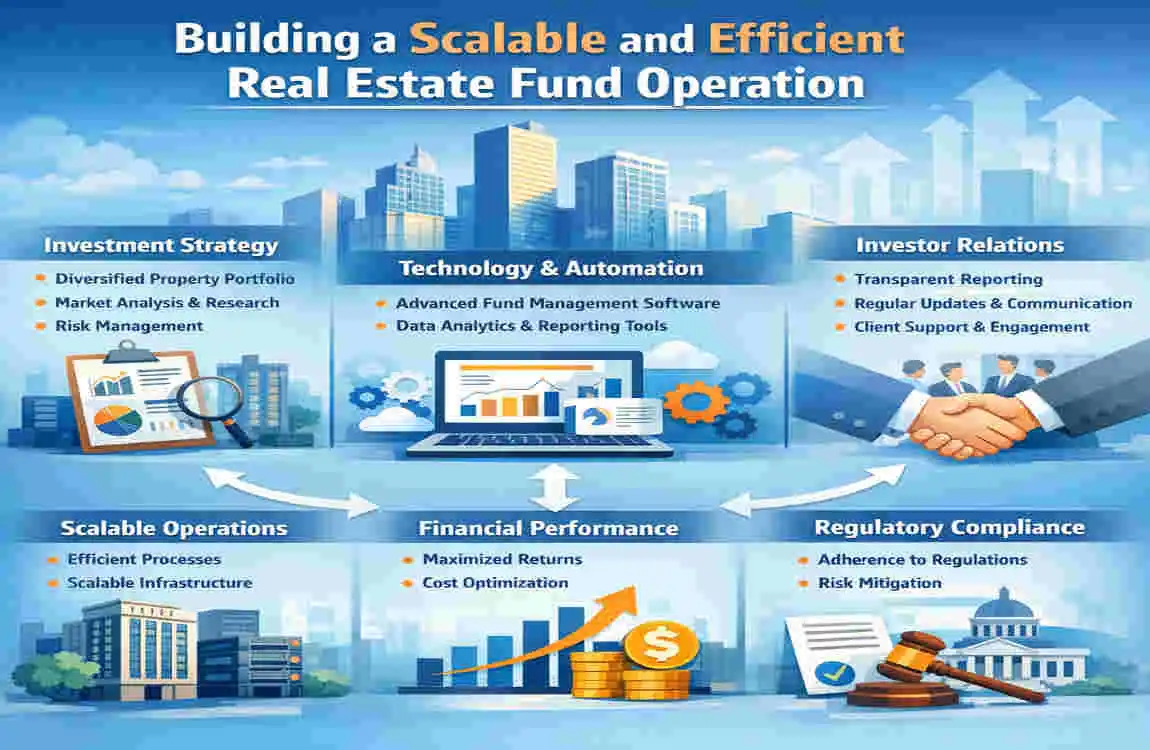
Building a Scalable and Efficient Real Estate Fund Operation
Design workflows that support growth
A good workflow should still work as the fund grows. That means using systems that can handle more properties, more investors, and more reporting without major strain.
Scalability starts with simple structure.
Outsource or keep work in-house.
Some tasks are better handled in-house. Others are more efficient when outsourced.
The key is to compare cost, quality, control, and flexibility. Do not outsource just because it seems easier. Do it when it truly improves efficiency.
Choose vendors based on value and scalability.
A cheap vendor is not always the best choice. Look at quality, response time, and long-term fit.
A provider that can grow with your fund may save more money over time than the lowest-priced option.
Improve communication between fund and property teams.
Miscommunication creates waste. When property teams and fund managers work from different information, mistakes happen.
Clear communication reduces delays and repeated work.
Standardize investor reporting
Investor reporting should be consistent, clear, and predictable. Standard report formats make the process faster and easier for everyone involved.
Train employees to use technology well.
Good software does little if the team does not know how to use it. Training improves adoption and reduces errors.
It also helps the fund get better value from the tools it already owns.
Measure operational efficiency
Do not guess whether your operation is efficient. Measure it.
Look at timing, cost, error rates, and response speed. Those numbers tell the real story.
Build a long-term overhead reduction strategy.
The best funds do not just cut costs once. They create a plan for continuous improvement.
That plan should cover systems, staff, vendors, technology, and process reviews.
FAQ: Solutions to Reduce Overhead in Real Estate Fund Management
What are the main sources of overhead in real estate fund management?
The main sources are administration, accounting, technology, legal support, staffing, and third-party services. Manual work and duplicate systems also drive up costs.
What are the most effective solutions to reduce overhead in real estate fund management?
The most effective solutions include automation, centralized platforms, standard processes, vendor review, and strong cost controls.
How can automation reduce real estate fund management costs?
Automation reduces manual work, lowers error rates, and speeds up reporting and administration. This saves both time and money.
Should real estate funds outsource administrative functions?
Sometimes yes. Outsourcing can help if it improves efficiency or lowers cost. But the decision should be based on value, not convenience alone.
How can technology improve real estate fund efficiency?
Technology helps organize data, speed up reporting, improve communication, and reduce repeated manual work.
How often should a real estate fund review its overhead expenses?
A fund should review overhead regularly, usually monthly or quarterly. More frequent reviews help catch waste earlier.
What KPIs can be used to measure real estate fund efficiency?
Useful KPIs include cost per asset, cost per investor, report turnaround time, and the share of automated workflows.
| Area | Efficiency Solution | Benefit |
|---|---|---|
| Property Management | Automate routine tasks | Reduces labor costs |
| Accounting | Use digital accounting systems | Saves time and improves accuracy |
| Vendor Management | Negotiate bulk service contracts | Lowers operating expenses |
| Technology | Use cloud-based fund software | Centralizes data and workflows |
| Reporting | Automate investor reports | Reduces administrative work |
| Maintenance | Schedule preventive maintenance | Helps avoid costly repairs |
| Staff Costs | Outsource non-core tasks | Controls payroll expenses |
| Energy Use | Install energy-efficient systems | Can reduce utility costs |
