

Imagine locking in a distressed house for $150,000, flipping the purchase contract to a cash buyer for $180,000, and pocketing a cool $30,000 for your efforts. Now, imagine doing all of this without ever taking out a mortgage, swinging a single hammer, or even officially owning the property. Sounds too good to be true, right?
Welcome to the exciting world of real estate investing in 2026. If you have been searching for a way to break into the property market but lack the massive capital usually required, you are in the right place. You are probably asking yourself, “What is wholesaling real estate, and how can everyday people use it to generate high income?”
Simply put, wholesaling real estate is the process of finding off-market, discounted house deals, getting them under contract with a motivated seller, and then assigning or selling that contract to an end buyer for a profit. You act as the ultimate middleman. You are connecting people who need to sell quickly with investors who are actively looking for their next flip or rental property.
As we navigate the shifting economic landscape in 2026, this strategy is gaining popularity. With rising inventory shortages in traditional markets and high interest rates making traditional flips riskier for beginners, wholesalers are stepping up to fill a massive gap. In fact, industry data shows that wholesalers closed significantly more deals in the first quarter of 2026 than in previous years, as distressed properties hit the market and cash buyers eagerly looked for off-market opportunities.
What Is Real Estate Wholesaling? The Beginner’s Breakdown
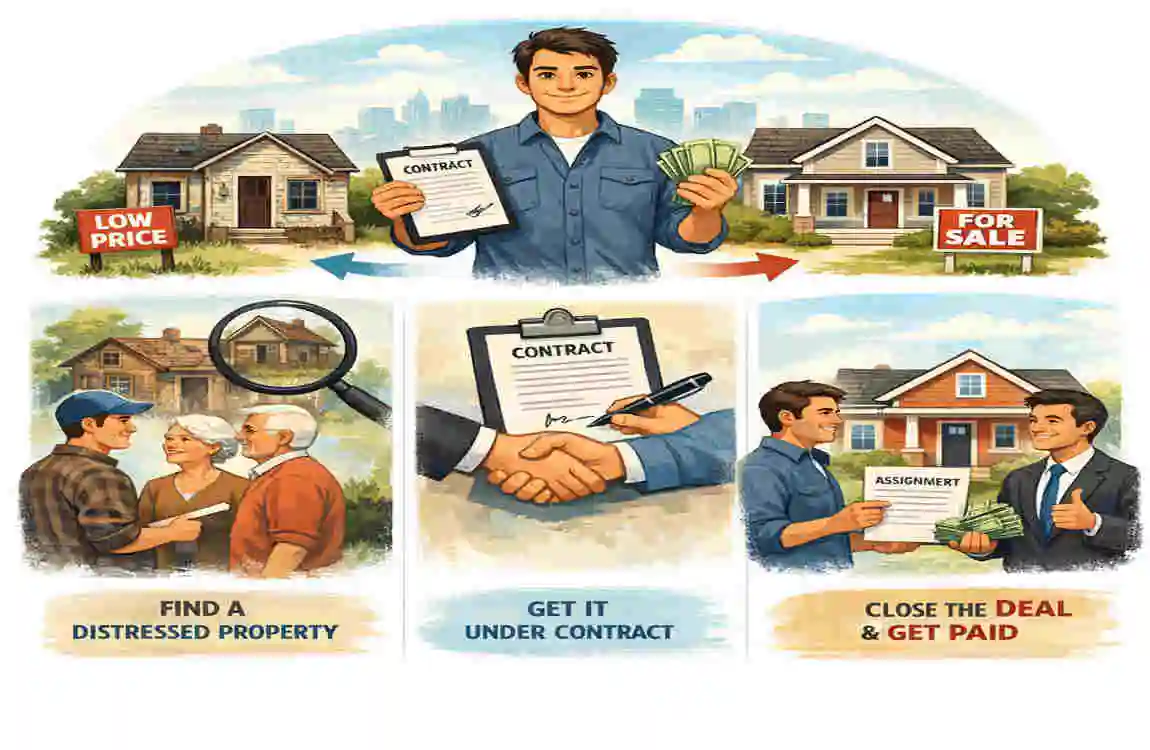
If you are new to investing, the terminology can feel overwhelming. Let us strip away the complex jargon and look at the absolute core of this business model.
Core Definition of Wholesaling Real Estate Houses
To answer the burning question of what wholesaling real estate is, you have to understand that you are not buying a house. Instead, you are buying the right to buy a house. It is a contract assignment strategy.
Here is how it works in plain English. You find a homeowner who needs to sell their house fast. This is often due to a stressful life event, such as a looming foreclosure, an inherited property they do not want, or a rental property with terrible tenants. They value speed and convenience over getting top dollar on the retail market.
You agree to buy their house for a specific price and sign a purchase agreement. However, your contract includes a special clause that allows you to “assign” it to someone else. You then take that contract to a real estate investor (your end buyer) who actually wants to buy and fix up the house. You sell them the contract for a higher price. The difference between what you promised the seller and what the investor pays you is your assignment fee. This fee can range anywhere from $5,000 to $50,000 per deal!
Wholesaling vs. Flipping vs. Renting: Quick Comparison Table
To help you visualize where wholesaling fits into the larger real estate universe, take a look at this quick comparison table. It highlights the differences between the three most popular investing strategies.
StrategyOwnership?Capital Needed Risk Level Average Profit Potential
Wholesaling No Low ($0 to $500 for marketing) , Very Low $10,000 to $30,000 per deal
Flipping Yes High (Down payments, repair costs) High $40,000+ per property
Renting Yes Medium (Down payments, reserves) Medium Steady, long-term passive income
Legal Basics: Contracts, Disclosures, and State Rules (2026 Updates)
While wholesaling is an incredible opportunity, you must play by the rules. The foundation of wholesale real estate deals is a rock-solid, assignable contract. Your standard purchase agreement must include the phrase “and/or assigns” next to your name as the buyer. This tiny phrase is what legally allows you to transfer your purchasing rights to your end buyer.
You also need to prioritize transparency. Always disclose to the seller that you are an investor looking to make a profit, and disclose to your buyers that you are assigning a contract, not selling a property you own.
It is also vital to stay up to date on the latest 2026 regulations. Several states, including Texas, Illinois, and California, have recently introduced stricter rules regarding wholesaling. In some areas, you may be required to hold a real estate license to wholesale legally, or you may be limited in how you can publicly market the property. Always consult a local real estate attorney to ensure your contracts and marketing methods comply with local laws.
Why Wholesale Real Estate in 2026? Market Opportunities for House Deals
You might be wondering why now is the perfect time to learn what wholesaling real estate is. The answer lies in the unique economic climate of 2026.
Following the massive market boom and subsequent stabilization of the past few years, the real estate landscape has fundamentally changed. We are seeing a noticeable inventory crunch in the traditional retail market. Normal homebuyers are struggling to find affordable houses, leaving real estate investors hungrier than ever for off-market deals.
Hot Markets and Inflation-Proof Income
Because traditional buyers are priced out, investors are actively targeting undervalued houses in the suburbs and secondary markets. They need inventory, and they are relying on wholesalers to find it for them. This creates a massive opportunity for you.
Furthermore, wholesaling provides a nearly inflation-proof income stream. Because you are not taking out massive bank loans or holding onto properties for months while paying utility bills and property taxes, your overhead remains incredibly low. You are generating quick cash injections that can help you outpace the rising cost of living.
The Rise of Virtual Wholesaling
Another massive trend in 2026 is the remote-friendly nature of this business. You are no longer restricted to investing in your own backyard. Thanks to technology, virtual wholesaling is booming. You can live in New York and easily wholesale properties in Ohio or Florida using digital signatures, online property data, and local “boots on the ground” contacts.
Interestingly, we are seeing global parallels to this model. For instance, in rapidly developing markets like the Lahore real estate sector in Pakistan, entrepreneurial investors are using similar contract-assignment schemes to acquire plots and distressed properties without massive capital. The principles of finding a deal and connecting it to a buyer are universal!
With top wholesalers easily averaging 2 to 5 deals every single month, the income potential is life-changing. Now, let us dive into the exact steps you need to take to get your slice of the pie.
Step-by-Step Guide: How to Wholesale Houses for Profit
This is the most important section of our guide. Grab a notebook, because we are going to walk through the exact, actionable steps you need to close your first wholesale deal.
Build Your Buyers List
Many beginners make the mistake of finding a house first and then scrambling to find a buyer. This is backward! You should always build your buyer list first.
Having a solid list of cash buyers means that the moment you get a house under contract, you already know exactly who to call to sell it. To find these cash buyers, start networking aggressively. Join local real estate investing groups on Facebook and LinkedIn. Attend local real estate networking events and property auctions.
When you meet a buyer, ask them what their specific buying criteria are. Do they want three-bedroom houses in a specific zip code? Are they looking for heavy fixer-uppers or light cosmetic rehabs? Keep all of this information highly organized. A simple, free tool like Google Sheets is a perfect Customer Relationship Management (CRM) system when you are just starting.
Find Motivated Seller Leads
Once you know what your buyers want, it is time to go hunting for wholesale real estate deals. You need to find “motivated sellers”—people who have a painful real estate problem that you can solve.
Free and Low-Cost Methods: If you are on a tight budget, try “driving for dollars.” This means getting in your car and driving through neighborhoods looking for distressed properties. Look for tall grass, boarded-up windows, or peeling paint. Write down the address, look up the owner on the local county tax assessor’s website, and reach out to them. You can also look for “For Sale By Owner” (FSBO) signs and call the owners directly.
Paid Marketing and Content Strategies: If you have some marketing capital, building SEO-optimized landing pages targeting keywords like “sell my house fast [your city]” is incredibly effective. However, to make this work, you need excellent marketing copy.
Creating valuable, relevant content for your specific audience is essential if you want your website to attract motivated sellers. When writing direct mail letters or website copy, you must be able to adapt your style and tone to connect emotionally with a seller who may be facing foreclosure or bankruptcy.
Your message needs to focus on providing a clear call to action that lets them know exactly how you can help them close quickly for cash. Furthermore, basic editing skills are crucial here; the ability to proofread and identify grammar and spelling errors ensures your marketing materials look professional and trustworthy to potential sellers.
Modern Tools: In 2026, software is your best friend. Tools like PropStream and BatchLeads now feature advanced AI capabilities that can predict which homeowners are most likely to sell, based on massive datasets.
Analyze Deals & Get Houses Under Contract
When a motivated seller finally calls you back, you need to determine if the house is actually a good deal. You do this using a specific math formula to calculate your Maximum Allowable Offer (MAO).
The Formula: ARV (After Repair Value) – Repair Costs – Your Wholesale Fee = Your Max Offer.
Let us break this down with a clear example. Imagine you are looking at a distressed house. You review recent sales of similar, fully renovated houses in the same neighborhood and determine that, once fixed up, this house would sell for $250,000. That is your ARV. You walk through the property and estimate it needs about $40,000 in repairs (a new roof, an updated kitchen, and fresh paint). You decide you want to make a $20,000 assignment fee for your efforts.
Let us do the math: $250,000 (ARV) Minus $40,000 (Repairs) Minus $20,000 (Your Fee) = $190,000 (Maximum Allowable Offer)
This means you cannot offer the seller a penny over $190,000 if you want the numbers to work for your cash buyer. Once you negotiate a price at or below your max offer, you sign a standard purchase agreement with the seller. Make sure your contract includes an inspection contingency period, which gives you time to back out legally if you cannot find a buyer.
Assign the Contract or Double Close
Now that you have the house under contract, call the people on your buyers’ list immediately. When a buyer says “yes,” you have two ways to close the deal.
The Assignment Route: This is the most common method. You and the cash buyer sign an “Assignment of Contract” agreement. The buyer gives you a non-refundable earnest money deposit. On closing day, the buyer steps into your shoes, buys the house directly from the seller, and the title company cuts you a check for your assignment fee. It is simple, clean, and requires zero of your own money.
The Double Close Route: Sometimes, you might negotiate a massive wholesale fee—say, $40,000. In an assignment, the seller and the buyer can see how much you are making on the final settlement statement. If you are worried the seller will get upset seeing your large fee, you can do a double close.
In a double close, you technically buy the house from the seller in Transaction A, and then immediately sell it to your cash buyer in Transaction B on the same day. To fund Transaction A without using your own money, you use short-term “transactional funding.” A very interesting trend in 2026 is the rise of crypto-funded transactional lending, which is enabling these double closes to happen faster and cheaper than ever before.
Scale to 5+ Deals a Month
Once you get your first deal under your belt, it is time to scale. You cannot do everything yourself forever.
To reach 5 or more deals a month, you need to automate your processes. Consider hiring Virtual Assistants (VAs) to handle your cold calling and administrative tasks. Upgrade from a simple spreadsheet to a robust CRM software like REI BlackBook. This allows you to set up automated text message follow-ups and email drip campaigns, ensuring no seller lead ever falls through the cracks.
Real Wholesaling Success Stories: Houses Flipped Without Ownership
Sometimes, the best way to understand what wholesaling real estate is is to hear from people who are actually doing it in the trenches.
Case Study 1: The Beginner’s Big Win. Take the story of Sarah, a teacher who wanted to create a secondary income stream. She spent three weekends “driving for dollars” in her local neighborhood. She spotted a house with an overgrown lawn and a tarp on the roof. She sent a simple, handwritten letter to the owner. It turned out the owner was an out-of-state landlord who was tired of dealing with the property. Sarah negotiated a purchase price of $120,000. She sent the deal to a local Facebook real estate group and assigned the contract to a flipper just four days later for $145,000. Sarah netted a massive $25,000 assignment fee on her very first try!
Case Study 2: The Virtual Wholesaling Master. Then there is the story of Marcus, a prime example of the 2026 virtual wholesaling boom. Living in an incredibly expensive coastal city, Marcus knew it would be tough to find local deals. He targeted the Midwest. Using software to pull lists of vacant properties in Ohio, he hired a VA to cold call the leads. He locked up a contract entirely over the phone and used a local mobile notary to get the seller’s signature. He then assigned the contract to an Ohio-based cash buyer he met on an online forum. Marcus made a $12,000 profit without ever setting foot in the state where the house was located.
These stories highlight common lessons: persistence pays off, and having a solid network of buyers is your most valuable asset.
Common Wholesaling Mistakes & How to Avoid Them
While wholesaling is beginner-friendly, it is not without its pitfalls. Making mistakes in this business can cost you time and reputation and potentially lead to legal trouble. Here are the most common blunders and how to dodge them.
- Overestimating the ARV (After Repair Value): This is the number one rookie mistake. If you tell a cash buyer a house is worth $300,000 fixed up, but it is really only worth $250,000, the buyer will lose trust in you instantly. Always be conservative with your numbers and rely on the “70% Rule” when analyzing deals for your buyers.
- Underestimating Repair Costs: If you guess a house needs $10,000 in work, but it actually needs a new foundation costing $30,000, your deal will fall apart. When in doubt, partner with a general contractor to walk you through your first few properties.
- Ignoring Buyer Verification: Never sign an assignment contract with a buyer who cannot provide a “Proof of Funds” letter or a recent bank statement. If your buyer backs out at the last minute because they do not actually have the cash, you will look terrible to the seller.
- Legal and Disclosure Slip-Ups: Never pretend you are buying the luxury house to live in it with your family. Be honest. Disclose that you are an investor looking to secure a profit. Transparency prevents lawsuits.
The Fix: Always use a standardized property checklist before making an offer to ensure you do not miss hidden damage.
Tools & Resources for Wholesaling Real Estate
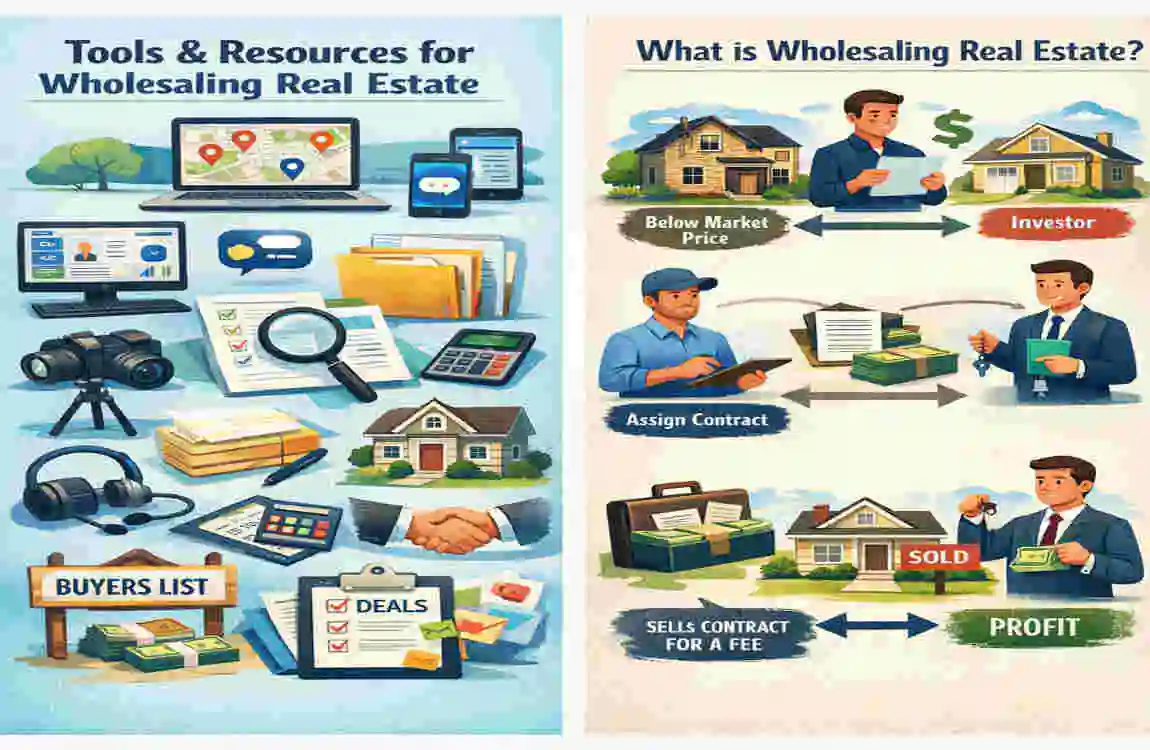
To run a professional wholesaling operation, you need the right tools in your digital toolbelt. Fortunately, the technology available to investors today is better than ever.
Essential Software:
- DealMachine: The ultimate app for driving for dollars. It tracks your route, allows you to snap a photo of a distressed house, and instantly pulls up the owner’s contact information.
- Podio: A highly customizable, free CRM that many top wholesalers use to track their leads, set follow-up reminders, and manage their buyer list.
Education and Networking:
- Podcasts: Shows like the “Wholesaling Inc.” podcast remain goldmines of free information. Listening to real-world interviews during your daily commute will dramatically shorten your learning curve.
- Industry Updates: Follow thought leaders like Tom Krol or Brent Daniels for the latest script updates and negotiation tactics.
Having the right resources transforms this from a confusing hobby into a streamlined, predictable business.
FAQs: Answering What’s Wholesaling Real Estate
Even after a deep dive, you likely still have some questions. Let us address the most common queries beginners have when entering this space.
What’s wholesaling real estate in the simplest terms? It is the business of finding heavily discounted, off-market property deals, securing the right to purchase the property through a contract, and then selling that contract (not the house itself) to a real estate investor for a profit.
Do I absolutely need a real estate license to wholesale? It depends entirely on your location. Historically, no license was required. However, as of 2026, several states have passed laws requiring wholesalers to hold a real estate license or limiting the number of deals they can do without one. Always consult a local real estate attorney to understand your specific state laws.
Can beginners really wholesale houses with absolutely no money? Yes, it is practically possible, but highly challenging. You do not need money to buy the house. Still, you usually need a small marketing budget (even $100 to $500) for things like gas for driving, printing direct mail letters, or running a basic website to generate seller leads.
What are the 2026 tax implications for assignment fees? Assignment fees are generally treated as active, ordinary, short-term earned income. They do not typically qualify for long-term capital gains tax rates because you are not holding a physical property for over a year. You should plan to set aside 25% to 30% of your profits for self-employment and income taxes. Always speak with a certified CPA.
