
Knowing a home’s value matters for many reasons. Homeowners want to understand their equity. Sellers want a fair asking price. Buyers want to know if a listing is overpriced. Investors want a quick sense of whether a deal makes sense.
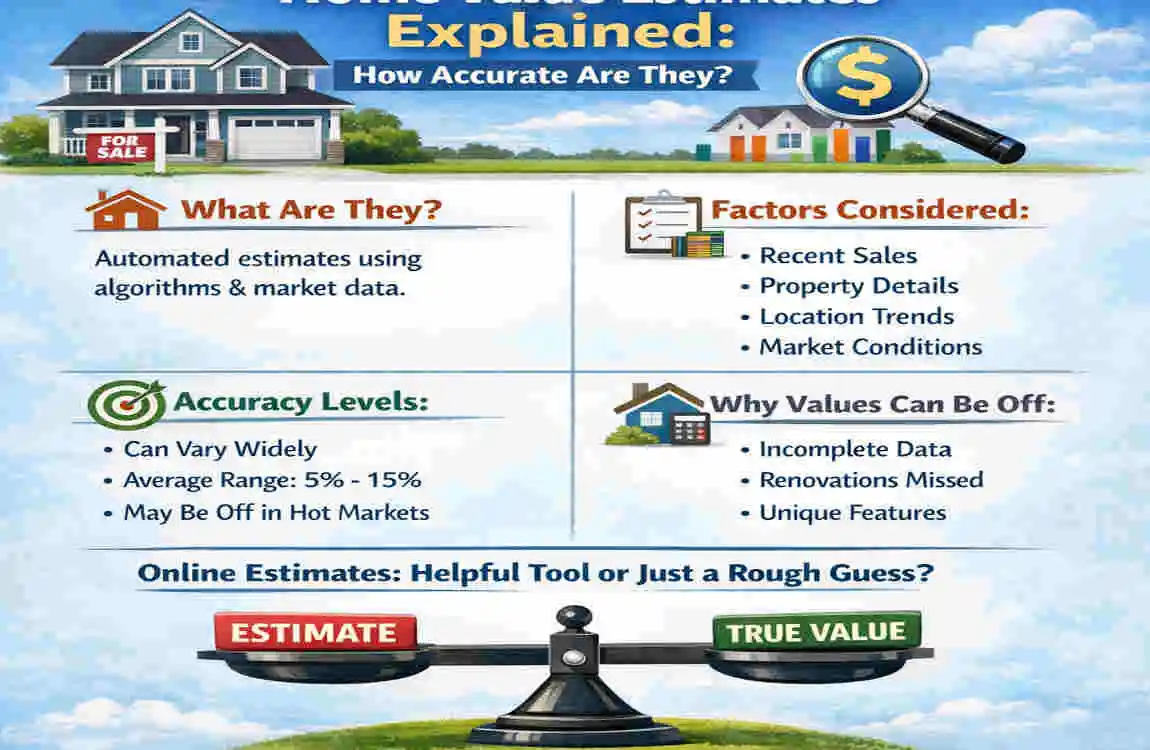
That is why the question “is real estate property value accurate?” comes up so often. The short answer is this: home value estimates are useful, but they are not always exact. They can give you a solid starting point, but they do not always reflect the full story of a home.
Online estimates are fast and convenient. Still, they can miss important details like upgrades, damage, neighborhood changes, or a home’s unique features. A professional appraisal is usually more detailed, but even that is not the same as a guaranteed sale price.
What Is a Real Estate Property Value Estimate?

Definition of Property Value
A property value estimate is a guess, or more politely, a calculated estimate of what a home might be worth in the current market.
It is helpful to understand the difference between a few related terms:
- Estimated value: A value created by an online tool or valuation method
- Listing price: The price a seller asks for
- Sale price: The price a buyer actually pays
- Appraised value: A professional opinion of value, often used by lenders
These numbers can be close, but they are not always the same.
How Home Value Estimates Are Created
Most home value estimates are based on data such as:
- Recent home sales nearby
- Home size and layout
- Number of bedrooms and bathrooms
- Lot size
- Public property records
- Market trends
Many websites use something called an automated valuation model, or AVM. That sounds technical, but it simply means a computer system looks at available data and provides an estimate.
Why Estimates Can Vary
Two websites can show different values for the same home because they may use different data, different formulas, and different update times.
One system may weigh recent sales more heavily. Another may focus more on square footage or neighborhood trends. That is why home values can shift from one source to another.
Is Real Estate Property Value Accurate?
How Accurate Are Online Home Estimates?
Online home estimates can be helpful for general research, but they are not always fully accurate.
They work best when there is plenty of good data available. If the area has many recent sales and the property records are correct, the estimate may be fairly close. But if data is missing or outdated, the number can be off.
So, if you are asking whether real estate property value is accurate, the answer is usually “sometimes, but not always.”
When Estimates Tend to Be More Accurate
Estimates are often more reliable when:
- The neighborhood has many recent comparable sales
- Property records are complete and updated
- Homes in the area are similar in size and style
- The market is stable
In these cases, the algorithm has more information to work with, so the result is usually better.
When Estimates May Be Less Accurate
Estimates can be weaker when a home is unusual or when market data is limited.
This happens often with:
- Custom-built homes
- Rural properties
- Recently renovated homes
- Homes with incorrect public records
- Fast-changing markets
If a house has special features or major upgrades, an online estimate may not fully notice them.
What Factors Affect a Home’s Estimated Value?
Location
Location is one of the biggest value drivers. Even two similar homes can have very different prices if they are in different areas.
Things that affect location value include:
- Neighborhood desirability
- Schools
- Parks and services
- Shopping and transportation
- Local market strength
A home in a highly desired area usually has stronger value than a similar home in a less desirable location.
Property Size and Layout
Square footage matters, but layout matters too. A larger home is not always more valuable if the floor plan feels awkward.
Useful factors include:
- Total square footage
- Number of bedrooms and bathrooms
- Lot size
- Flow of the floor plan
A practical layout often adds more value than a bigger but poorly designed home.
Condition and Improvements
A well-maintained home usually gets a better estimate than one that looks worn or outdated.
Important improvements may include:
- Kitchen updates
- Bathroom remodels
- New roof
- New windows
- HVAC upgrades
- New flooring
Still, not every improvement increases value dollar for dollar. Buyers often value upgrades differently depending on style and local demand.
Comparable Properties
Comparable properties, often called comps, are homes similar to yours that recently sold nearby.
These matter because they show what buyers have actually paid. That makes them much more useful than asking prices alone.
Market Conditions
Home value also changes with the market.
Factors include:
- Supply and demand
- Interest rates
- Buyer competition
- Seasonal trends
If demand is strong and inventory is low, values may rise. If more homes are for sale and fewer buyers are active, values may soften.
Online Home Value Estimates vs. Professional Appraisals
FeatureOnline EstimateProfessional Appraisal
Speed Usually immediate Takes more time
Cost Often free Usually costs money
Property Inspection Usually no Typically includes one
Data Used Automated/public data Market data plus expert analysis
Accuracy Varies Usually more detailed
Best Use Early research Lending and formal valuation
When to Use an Online Estimate
An online estimate is useful when you want a quick starting point.
It is good for:
- Early research
- Planning to sell
- Checking neighborhood pricing
- Comparing homes in an area
It gives you direction, not a final answer.
When to Consider a Professional Appraisal
You should think about a professional appraisal when accuracy really matters.
This includes:
- Mortgage financing
- Estate matters
- Legal situations
- Major financial decisions
- Large differences between online estimates
If money, taxes, or a loan are involved, a professional opinion is usually the safer choice.
How to Get a More Accurate Home Value
Check Recent Comparable Sales
Start by looking at homes that recently sold, not just those listed for sale.
Focus on homes that are close in:
- Size
- Age
- Condition
- Location
Sold prices tell you much more than asking prices.
Review Your Property Information
Sometimes online tools use incorrect details. That can throw off the estimate.
Check for:
- Wrong bedroom count
- Wrong bathroom count
- Incorrect square footage
- Missing renovations
- Outdated property records
Even small errors can affect the final number.
Consider Recent Improvements
Upgrades can matter, but not every improvement adds the same amount of value.
For example, a new roof or updated kitchen may help more than a cosmetic change. Still, the market decides how much value buyers are willing to pay.
Compare Multiple Estimates
Do not rely on just one source. Compare several estimates to find a general range.
If most of them are close, that gives you more confidence. If one is far off, it may be missing data.
Consult a Local Real Estate Professional
A local agent can provide a comparative market analysis, or CMA. This is not the same as an appraisal, but it uses local market knowledge and recent sales.
That local insight can make a big difference.
Common Mistakes When Using Home Value Estimates
Treating an Estimate as an Exact Price
An estimate is not a promise. It is only a guide.
A home may sell above or below its estimated value depending on demand, timing, and condition.
Ignoring Property Condition
Online tools usually cannot see the inside of your home. They may not know if the kitchen is outdated or if the roof needs work.
That means condition can change value a lot.
Comparing With the Wrong Homes
Do not compare your home with properties that are too different.
Bad comparisons include homes that differ in:
- Size
- Age
- Location
- Quality
- Lot type
Better comps create better estimates.
Focusing Only on Asking Prices
Asking prices are just what sellers hope to get. Sold prices are what buyers actually pay.
That difference matters a lot.
Ignoring Local Market Changes
Markets move quickly. A value estimate from months ago may already be outdated.
If buyer demand changes, your home value can change too.
Why Property Values Change Over Time
Economic Conditions
The broader economy affects home prices. Factors such as employment, inflation, interest rates, and consumer confidence can influence demand.
When people feel financially stable, they may be more willing to buy. When borrowing becomes expensive, demand can slow down.
Neighborhood Development
New roads, businesses, parks, and schools can improve an area’s appeal.
That can raise demand and support higher property values.
Housing Supply and Demand
If there are not enough homes for sale, buyers compete more strongly. That can push values upward.
If many homes are available, buyers have more choices and sellers may need to lower prices.
Property-Specific Changes
A home changes over time too.
Value can shift because of:
- Renovations
- Wear and tear
- New additions
- Landscaping
- Poor maintenance
A well-cared-for home usually keeps value better than one that has been neglected.
How Sellers Can Use Home Value Estimates
If you are selling, use estimates as a starting point only.
Here is a simple way to use them wisely:
- Check several online estimates
- Compare them with recently sold homes
- Ask a local agent for a CMA
- Set a price that reflects real market conditions
This helps you avoid overpricing your home based on an optimistic number.
How Buyers Can Use Property Value Estimates
Buyers can use estimates to judge whether a home seems fairly priced.
They can help you:
- Compare the asking price with nearby sales
- Spot possible overpricing
- Understand the local price range
- Plan for repair or upgrade costs
But remember, estimates are only part of the picture. Condition, inspection results, and future repair needs also matter.
How Investors Can Use Property Value Estimates

Investors often use estimates as a quick screening tool.
They can help you:
- Compare purchase price with value
- Decide whether a property is worth a closer look
- Estimate possible profit range
- Screen out bad deals early
Still, investors should verify key figures against local sales data and renovation costs. A single automated estimate is never enough.
FAQ: Is Real Estate Property Value Accurate?
Is real estate property value accurate?
Property value estimates can be useful, but they are not always exact. Accuracy depends on data quality, comparable sales, location, condition, and current market conditions.
Are online home value estimates reliable?
They are reliable enough for general research, but not always exact. Use them as a starting point, not the final answer.
Why do different websites give different home values?
Different websites use different data, update schedules, and formulas. That is why values can vary.
What is the most accurate way to determine home value?
A mix of recent sales, local market knowledge, a comparative market analysis, and sometimes a professional appraisal gives the best result.
Can a house sell for more than its estimated value?
Yes. Strong demand, limited inventory, or special features can push a sale price above the estimate.
Should I trust an online home estimate when selling?
Use it as a guide, but do not rely on it alone. Recent sales and local professional advice are usually more helpful.
