

Knowing how to determine a home’s value matters whether you are buying, selling, refinancing, or simply planning. A home’s value can change based on location, size, condition, upgrades, and market demand. That means there is no single number that fits every home.
What Is Real Estate Home Value?
Market Value vs. Asking Price
Market value is the amount a buyer is likely to pay for a home in the current market. Asking price is the number the seller chooses to list it for.
These two numbers are not always the same. A seller may ask for more because of emotion or market hopes, while the real market value may be lower based on recent sales.
Why Home Value Matters
Home value affects many important decisions:
- Buying or selling
- Setting a listing price
- Refinancing
- Measuring equity
- Making investment choices
If you know the value, you can make better and more confident decisions.
Factors That Influence Home Value
Several things shape a home’s value:
- Location
- Property size
- Bedrooms and bathrooms
- Age and condition
- Renovations and upgrades
- Neighborhood features
- Local supply and demand
Even small differences can change the final number.
How to Determine Real Estate Home Value
Research Recent Comparable Sales
One of the best ways to estimate value is by looking at comparable properties, often called comps. These are homes that recently sold near your property.
Try to compare homes with similar:
- Size
- Layout
- Age
- Condition
- Features
Recently sold homes are more useful than active listings because they show what buyers actually paid, not just what sellers hoped to get.
Compare Price Per Square Foot
A simple way to start is with this formula:
Price per square foot = Sale price ÷ Property size
For example, if a home sold for $400,000 and is 2,000 square feet, the price per square foot is $200.
This can help you estimate value, but do not use it alone. A home in better condition, in a better location, or with better upgrades may be worth more.
Evaluate the Property’s Condition
A home’s condition matters a lot. Buyers usually pay more for homes that feel well cared for.
Look at:
- Roof and exterior
- Kitchen and bathrooms
- Flooring and finishes
- HVAC, plumbing, and electrical systems
- Structural condition
- Maintenance needs
A home that needs major repairs will usually have a lower value than a similar home in excellent shape.
Consider Location and Neighbourhood
Location is one of the biggest value drivers. Even two similar homes can have very different prices if they are in different areas.
Think about:
- School quality
- Transportation access
- Shops and restaurants
- Parks and recreation
- Safety
- Future development
A strong neighbourhood can raise property values, while a weak one can lower them.
Use Online Home Value Estimates Carefully

What Online Valuation Tools Do
Online home value tools use computer models called automated valuation models, or AVMs. They look at property records, recent sales, and market trends to create an estimate.
These tools are useful, but they are only a starting point.
Benefits and Limitations
Online estimates are:
- Fast
- Easy to use
- Helpful for a quick check
But they also have limits. They may miss:
- Recent renovations
- Special features
- Unique lot sizes
- Local market details
They can also be less accurate in areas with very few comparable sales.
Don’t Rely on One Estimate
It is better to compare several sources. Use online estimates, recent comps, and local market knowledge together.
Instead of looking for a single exact number, try to find a reasonable range of values.
Get a Comparative Market Analysis or Professional Appraisal
Comparative Market Analysis (CMA)
A comparative market analysis is a report prepared by a real estate professional. It compares your home to similar homes in the area that recently sold or are for sale.
A CMA can be very helpful if you are:
- Selling a home
- Buying a home
- Checking pricing before listing
Professional Home Appraisal
A home appraisal is a more formal valuation done by a licensed appraiser. Lenders often require it during mortgage transactions.
A CMA and an appraisal are not the same. A CMA helps estimate market price, while an appraisal is a more official opinion of value.
When Professional Help Makes Sense
Professional help is especially useful when the property is:
- Unique
- Luxury-priced
- Recently renovated
- Hard to compare
- Involved in estate, divorce, or financial planning
If accuracy matters a lot, this step is worth it.
Common Mistakes When Estimating Home Value
Comparing With the Wrong Properties
Do not compare a small home to a much larger one, or a remodelled home to one that needs major repairs. That can throw off the estimate.
Always compare homes that are similar in size, age, condition, and location.
Overvaluing Renovations
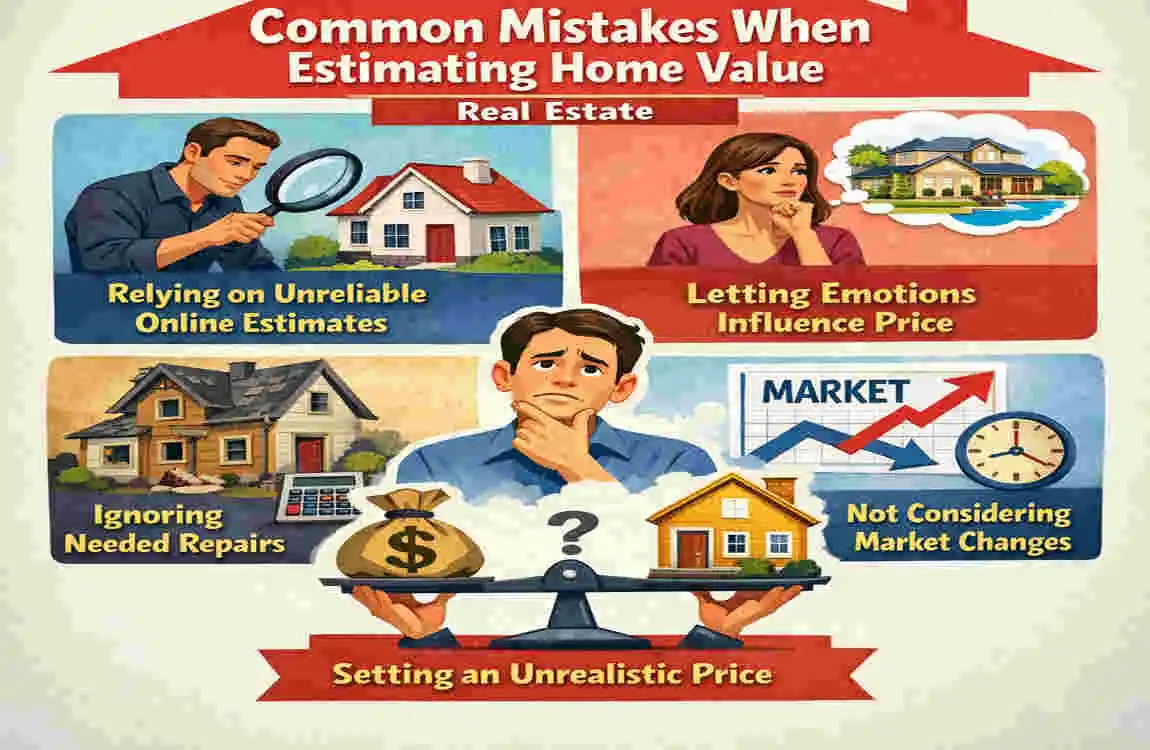
Not every upgrade adds value equal to what you spent. A very expensive renovation may not return every dollar in market value.
Focus on improvements buyers actually want, like:
- Updated kitchens
- Modern bathrooms
- Better curb appeal
- Functional layouts
Ignoring Current Market Conditions
Market value changes with demand, inventory, and mortgage rates. A sale from a year ago may not reflect today’s market.
Always use recent data when possible.
Letting Emotional Value Influence the Estimate
It is easy to value your home based on memories. But sentimental value is personal, not market-based.
Try to stay objective and use facts instead of feelings.
A Simple Home Value Calculation Example
Gather Comparable Sales
Start with three to five recent comparable sales in your area. Pick homes that are close in size and style.
Calculate a Basic Value Range
Check their sale prices and price per square foot. Then adjust for differences in condition, location, and upgrades.
Create a Realistic Estimate
Use the data to define a range of values, not just a single exact number.
FAQs About Determining Real Estate Home Value
How do you determine real estate home value?
You estimate it by comparing recent sales, property size, condition, location, upgrades, and market trends.
What is the easiest way to estimate a home’s value?
The easiest way is to use online valuation tools and compare them with recent comparable sales.
Is price per square foot a good way to determine home value?
Yes, but only as a guide. It is helpful, but it should not be the only factor.
What makes a house increase in value?
Good location, strong condition, smart upgrades, high demand, and a healthy market can all increase value.
Can I determine my home’s value without an appraiser?
Yes. You can make a solid estimate on your own, but an appraiser gives a more formal result.
How accurate are online home value estimates?
They can be useful, but accuracy depends on the amount of data available and how unique the home is.
Should I use the tax-assessed value as my home’s market value?
Not always. Assessed value is used for taxes and may differ significantly from true market value.
| Method | What to Check | Why It Matters |
|---|---|---|
| Comparable Sales | Prices of similar nearby homes | Shows current market value |
| Location | Neighborhood, schools, transport, amenities | Location strongly affects demand |
| Property Size | Home and lot square footage | Larger properties often have higher values |
| Condition | Age, repairs, renovations, and maintenance | Well-maintained homes can command better prices |
| Features & Upgrades | Kitchen, bathrooms, garage, outdoor spaces | Desirable features can increase value |
