
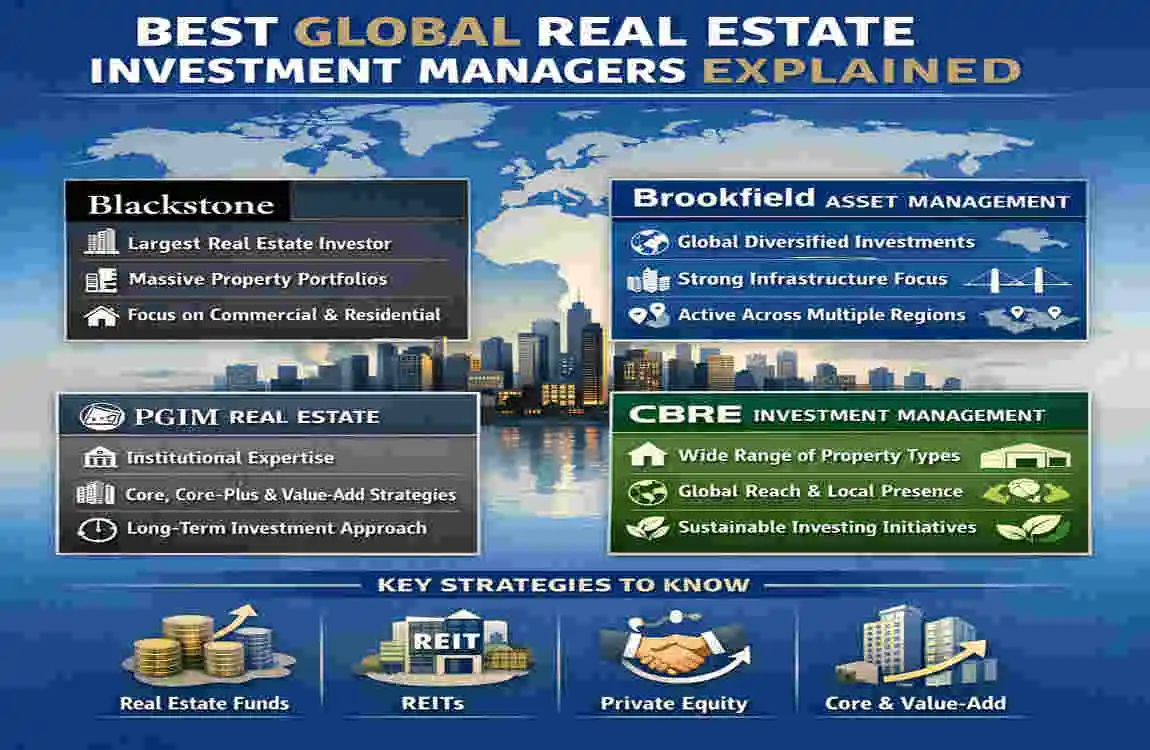
Global real estate can give investors access to many markets, property types, and investment styles. That is a big reason people look at professional managers instead of trying to do everything alone. These firms study markets, find opportunities, manage properties or portfolios, and try to build a stronger mix of assets over time.
For many investors, the real value comes from diversification. That means spreading money across different countries, different sectors, and different investment strategies. When done well, diversification can help reduce the effect of a single weak market or one problem property. It does not remove risk, but it can make a portfolio more balanced.
What Are Global Real Estate Investment Managers?

Definition and Role
A global real estate investment manager is a firm that manages property investments across several regions or countries. These managers do not just buy buildings. They also research markets, choose assets, manage risk, and decide when to sell.
Their job is broader than a developer, broker, or property manager. A developer focuses on building or improving real estate. A broker helps buyers and sellers make deals. A property manager handles day-to-day operations such as rent collection, maintenance, and tenant services. A real estate investment manager sits above all of that and looks at the investment picture as a whole.
In simple terms, they try to answer questions like “Where should we invest?” Which property type is strongest? How much risk should we take? When should we hold and when should we exit?
Why Investors Use Global Managers
Many investors use global managers to access markets they may not know well. Real estate in one country can behave very differently from real estate in another. A strong manager can help an investor reach opportunities in North America, Europe, Asia-Pacific, and sometimes emerging markets.
Another reason is local knowledge. Real estate is highly local. A good building in the wrong neighborhood or the wrong city can become a weak investment. Global managers often have teams on the ground who understand regulations, tenant demand, pricing trends, and market cycles.
They also bring discipline. Instead of buying a single property based on guesswork, they use research, screening, and portfolio planning. That can improve decision-making and reduce emotional investing.
Common Investment Vehicles
Global real estate managers usually work through several investment structures. Some of the most common include:
- Private real estate funds
- REITs and listed real estate strategies
- Separate accounts
- Joint ventures and co-investments
Each structure serves a different type of investor. Private funds may appeal to institutions or high-net-worth investors who want a managed pool. REITs may suit investors who want easier buying and selling through public markets. Separate accounts allow a manager to follow one client’s goals more closely. Joint ventures can bring together local partners and global capital.
How Global Real Estate Managers Diversify Portfolios
Geographic Diversification
One of the strongest tools in real estate investing is geographic diversification. This means spreading investments across different cities, regions, and countries rather than relying on a single market.
A manager may invest in North America, Europe, and Asia-Pacific simultaneously. Some may also look at emerging markets when the risk-reward balance makes sense. The goal is not just to own property in many places. The goal is to own property in markets that do not all move in the same direction.
This matters because every region follows its own cycle. One market may be slowing while another is growing. If a portfolio is too concentrated in one area, a local slowdown can hurt returns. Geographic spread helps soften that impact.
It also brings extra considerations. Currency changes can affect performance. Political shifts can change regulations. Tax rules can vary from one country to another. Good managers think about all of this before they invest.
Property-Type Diversification
Another major way to diversify is by property type. Real estate is not just office buildings. It includes a wide range of uses, and each one behaves differently.
Common sectors include:
- Residential and multifamily
- Office buildings
- Industrial and logistics
- Retail
- Hotels and hospitality
- Data centers and other alternative real estate
Residential and multifamily properties can be supported by steady housing demand. Industrial and logistics assets often benefit from e-commerce and supply chain needs. Retail can work well in the right location, though it faces more change than some other sectors. Hotels may rise and fall with travel trends. Data centers have become more important as digital demand grows.
The smart move is not to chase every sector. It is to build a mix that fits the investor’s goals and the market outlook.
Strategy Diversification
Real estate managers also diversify by investment strategy. This is about how much risk they are willing to take and how much value they expect to create.
Common strategies include:
Core
Core investing focuses on stable, income-producing properties in strong locations. These assets are usually lower risk and more predictable. The tradeoff is that they may offer lower growth potential.
Core-Plus
Core-plus is a step up in risk. These assets remain relatively stable, but they may need minor improvements, better management, or lease-up work. The return potential can be higher than pure core.
Value-Add
Value-add strategies target properties that need active improvement. This may include renovations, repositioning, or stronger leasing plans. These investments can create more upside, but they also bring more risk.
Opportunistic
Opportunistic investing is the highest-risk style among the main categories. These projects may involve development, major redevelopment, distressed assets, or complex turnaround situations. The reward can be high, but the outcome is less certain.
Development-Focused
Some managers also run development strategies. These involve building new properties or completing major projects from the ground up. Development can create strong value, but it depends heavily on costs, timing, demand, and execution.
Why Diversification Matters
Diversification matters because real estate is cyclical. Markets rise, slow down, recover, and sometimes face stress. A single sector can also weaken if demand changes.
By spreading capital across several areas, a manager can reduce concentration risk. That means a weak market or a struggling tenant group should have less impact on the overall portfolio.
Diversification also helps balance income and growth. Some assets produce stable cash flow. Others offer more upside if they improve or sell well later. A good manager uses both thoughtfully.
Still, diversification is not magic. It cannot remove every risk. It only helps reduce the chance that a single issue harms the entire portfolio too much.
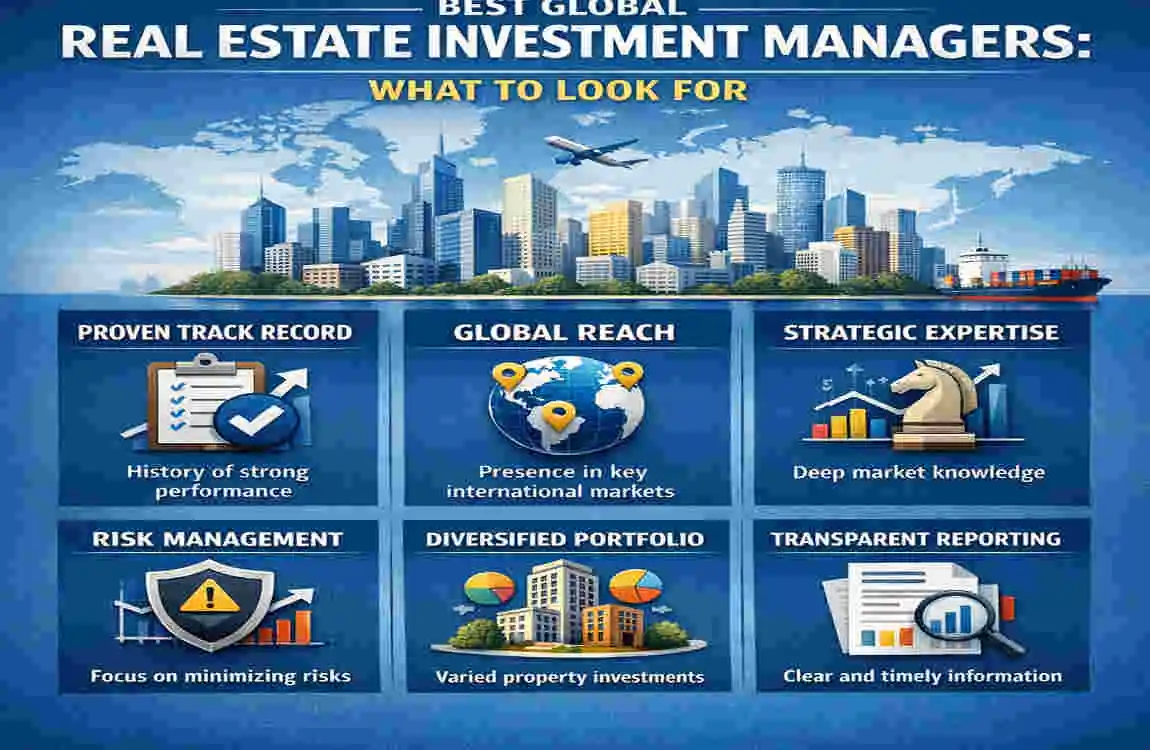
Best Global Real Estate Investment Managers: What to Look For
Investment Track Record
A manager’s track record tells you a lot about how they invest. Look at how long the firm has been active, what kinds of markets it has worked in, and how it has performed across different cycles.
A strong track record is not just about high returns in one good year. It is about consistency. You want to know whether the manager made good decisions in both strong and weak markets.
You should also ask how they handled stress. Did they protect capital when markets turned? Did they stay disciplined when pricing became too high? These details matter.
Global Reach and Local Expertise
The best global managers usually combine broad reach with local knowledge. They may have offices in major cities across several continents, but they also need teams who understand each market in detail.
Real estate works best when local experts help guide the investment process. They can spot trends early, know the right neighborhoods, and understand local rules and tenant behavior.
That mix of global scale and local insight is often what separates average managers from strong ones.
Portfolio Diversification
When you compare managers, do not just ask how many countries they cover. Ask how they diversify at every level.
Look at:
- Markets served
- Property sectors covered
- Investment strategy mix
- Tenant diversity
- Asset diversity
A manager may be global on paper but still be highly concentrated in a single sector or tenant type. True diversification is wider and deeper than that.
Risk Management and Transparency
Good managers do not only chase returns. They also protect against avoidable mistakes. That means they use solid due diligence, sensible leverage, and clear valuation methods.
Transparency is equally important. Investors should be able to understand what they own, how the assets are valued, what fees they pay, and what risks they face.
You should also ask about:
- Liquidity
- Leverage
- Fee structure
- Potential conflicts of interest
- Reporting frequency
The clearer the communication, the easier it is to trust the manager.
Leading Global Real Estate Investment Managers to Know
Editorial note: Instead of ranking firms from #1 to #10, it is usually better to compare established managers on strategy, geographic reach, asset-class expertise, track record, fees, and investor fit.
Brookfield Asset Management
Brookfield is one of the best-known names in global real assets. It has a large international footprint and invests across property types, infrastructure, and related asset classes.
The firm is known for a broad, flexible approach. It often targets long-term value and large-scale opportunities. Its portfolio can include office, industrial, retail, residential, and alternative assets depending on the strategy.
Brookfield is notable for its global scale and ability to operate across many regions. It often appeals to institutional investors looking for diversification and a strong platform.
Blackstone
Blackstone is one of the biggest real estate investors in the world. It has a major global presence and a wide range of strategies.
Its real estate platform has invested in industrial, logistics, multifamily, hospitality, office, and data-driven sectors. Blackstone is especially known for scale, research, and active portfolio management.
It tends to be notable for its reach, speed, and ability to move into growing sectors. Many investors view it as a major force in institutional real estate.
Nuveen Real Estate
Nuveen Real Estate has a broad global platform and works across a wide set of property types and strategies. It serves institutional clients and is known for a disciplined investment process.
Its global footprint supports investments in major markets across North America, Europe, and Asia-Pacific. The firm often focuses on income, core holdings, and long-term portfolio construction.
Nuveen stands out for its long-standing presence and ability to serve investors seeking a more balanced and steady approach.
PGIM Real Estate
PGIM Real Estate is another major global manager with a wide footprint and a strong institutional base. It invests across many regions and property sectors.
The firm’s approach often includes both core and higher-return strategies, which gives it flexibility. It also places strong emphasis on research and market analysis.
PGIM Real Estate is notable for its size, global platform, and broad investor relationships. It is often used by institutions that want access to multiple markets within a single managed structure.
LaSalle Investment Management
LaSalle Investment Management is well known for real estate research and portfolio management. It has a strong international network and a long history in the sector.
The firm works across offices, industrial, residential, retail, and alternative assets, depending on the strategy. It is often appreciated for disciplined analysis and market insight.
LaSalle stands out for its heavy focus on research-driven investment decisions. That appeals to investors who value careful market selection.
Hines
Hines is a global real estate organization with a strong reputation in development, investment, and asset management. It has a long history and a broad international presence.
Its activities may include office, residential, industrial, mixed-use, and specialized projects. Hines often combines development skill with investment discipline.
What makes Hines notable is its depth in real estate. It is not just an investment platform. It also has strong experience in building and operating real estate.
Invesco Real Estate
Invesco Real Estate has a global platform and a wide set of strategies for institutional investors. It focuses on finding property opportunities across many markets.
Its portfolio can include office, residential, industrial, retail, hotel, and alternative real estate assets. The firm often emphasizes diversification and local market knowledge.
It is notable for serving a wide range of clients and for bringing a global approach to portfolio construction.
Benefits and Risks of Global Real Estate Investment Management
Potential Benefits
Global real estate managers can offer several clear advantages. First, they open the door to broader investment opportunities. Instead of being limited to a single market, investors can access multiple regions and sectors.
Second, they provide professional management. That means experienced teams handle research, due diligence, property selection, and portfolio oversight.
Third, they can help investors reach specialized sectors. Data centers, logistics hubs, and niche property types are often easier to access through a manager than on one’s own.
Fourth, they support geographic and asset diversification. This can help spread risk and improve portfolio balance.
Finally, real estate can offer income and long-term capital appreciation, depending on the strategy and market conditions.
Key Risks
Even the best manager cannot remove all risk. Real estate still faces market downturns, rate changes, and operating problems.
Some of the main risks include:
- Property-market downturns
- Currency fluctuations
- Interest-rate changes
- Political and regulatory risk
- Liquidity limits
- Leverage and financing risk
- Management and operational risk
If one country weakens, if interest rates rise sharply, or if financing becomes expensive, returns can suffer. That is why investors should never assume that diversification means safety without limits.
How Investors Can Compare Managers
A simple comparison table can help you think clearly about the differences.
Factor What to Check
Global reach Countries and regions covered
Asset classes Residential, office, industrial, retail, alternatives
Strategy Core, core-plus, value-add, opportunistic
Track record Historical experience and performance
Diversification Markets, properties, tenants, sectors
Fees Management and performance fees
Risk management Leverage, liquidity, due diligence
Transparency Reporting and investor communication
This kind of comparison helps you focus on fit, not just brand name.
How to Choose the Right Global Real Estate Investment Manager

Match the Manager to Your Goals
Start with your own goals. Are you looking for stable income? Long-term growth? Capital preservation? Higher-risk upside?
A manager that fits one goal may be wrong for another. For example, a core strategy may suit someone who wants steadier income. An opportunistic strategy may suit someone who wants higher growth and can accept more uncertainty.
Your goal should lead the choice, not the other way around.
Evaluate Diversification
Do not stop at the word global. Look deeper. Ask how the manager diversifies across sectors, tenants, countries, and strategies.
A portfolio with many properties is not automatically well diversified. Even if all the assets are in one sector or economy, the portfolio still carries concentration risk.
Also ask whether the diversification actually matches your risk tolerance. More spread is not always better if it introduces unwanted complexity.
Review Fees and Structure
Fees can have a big effect on total returns. Look at management fees, performance fees, operating expenses, and any other costs built into the structure.
Also check lock-up periods and minimum investment requirements. Some vehicles are less liquid than others, and that matters if you may need access to capital later.
If the structure is hard to understand, ask for a simpler explanation before you invest.
Perform Due Diligence
Before committing money, review the offering documents carefully. Understand what the manager plans to buy, how they plan to manage it, and when they expect to sell.
You should also check how the firm handles governance, reporting, and valuation. These are not exciting topics, but they are important.
If needed, consider independent professional advice. That can help you understand whether the opportunity fits your overall portfolio.
FAQs About Global Real Estate Investment Managers
What are global real estate investment managers?
They are professional firms that manage real estate investments across several countries and property sectors. They research markets, acquire assets, manage risk, and decide when to sell.
Why is diversification important in global real estate investing?
Diversification helps reduce concentration risk. By spreading investments across regions, sectors, and strategies, a manager can limit the impact of a single weak market or a poorly performing asset.
What are the top global real estate investment managers’ diversification strategies?
The main strategies are geographic diversification, property-sector diversification, investment-style diversification, and overall portfolio risk management.
Are global real estate investment managers suitable for individual investors?
Sometimes yes, but it depends on the structure, minimum investment size, liquidity, and risk tolerance. Some products are more accessible than others.
What property types do global real estate managers invest in?
They may invest in residential, office, industrial, retail, hospitality, logistics, data centers, and other specialized assets.
How do I compare global real estate investment managers?
Compare track record, strategy, diversification, fees, transparency, risk management, and investor requirements. A good fit matters more than a famous name.
Does global diversification guarantee lower risk?
No. Diversification can reduce concentration risk, but it cannot eliminate market, currency, economic, or management risks.
| Investment Manager | Main Focus | Key Strength |
|---|---|---|
| Blackstone Real Estate | Commercial & residential property | Global scale and diversified portfolios |
| Brookfield Asset Management | Office, retail, industrial & infrastructure | Long-term investment approach |
| Prologis | Logistics and industrial real estate | Strong focus on warehouses and distribution |
| CBRE Investment Management | Global real estate assets | Broad investment strategies and market expertise |
| Nuveen Real Estate | Residential, retail, office & industrial | Diversified global portfolio |
| Hines | Development and property investment | Strong international presence |
