
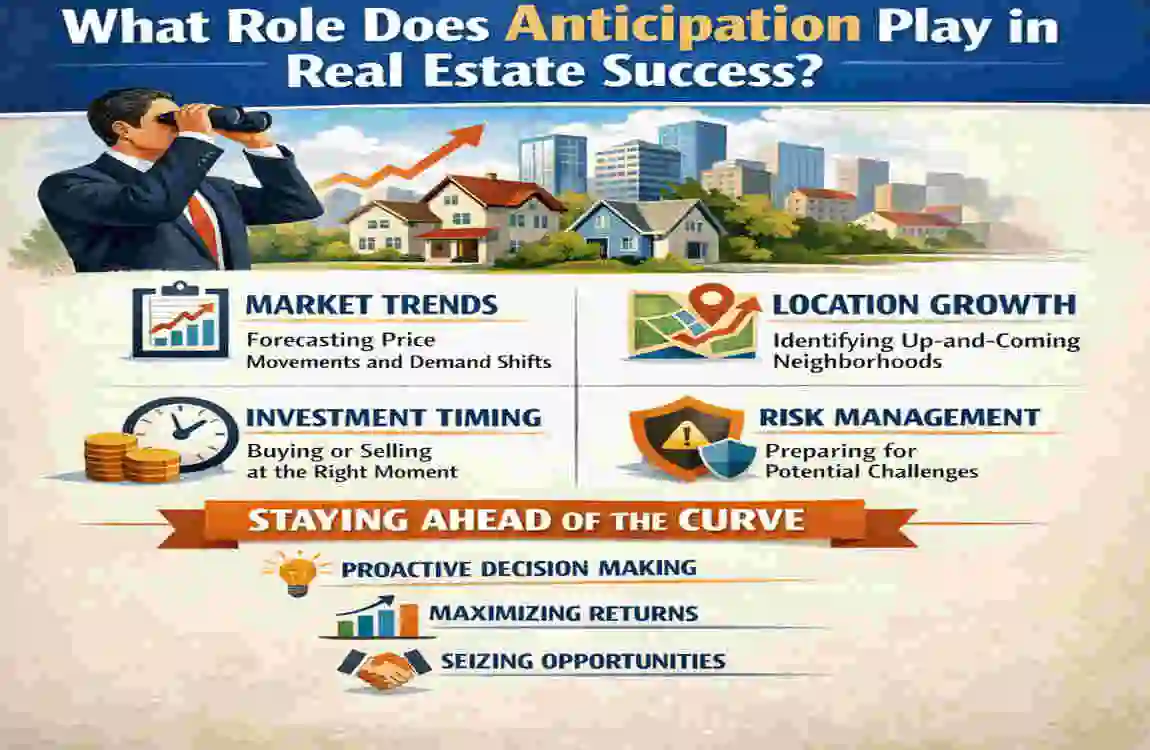
Anticipation in real estate means thinking ahead before the market forces you to act. It is the skill of noticing what may happen next and preparing for it early. In simple words, it is about being ready before everyone else catches on.
This matters a lot because the property market does not stay still. Prices change, interest rates move, buyers shift their preferences, and new neighborhoods grow faster than people expect. If you wait too long, you may miss a good deal, lose profit, or make a poor decision based on old information.
That is why forward-thinking is so important in today’s real estate market. Whether you are a buyer, seller, investor, or agent, your results often depend on how well you understand the future direction of the market. The people who succeed are usually not the ones who react. They are the ones who prepare early, study trends, and make decisions with a clear plan.
Understanding Anticipation in Real Estate
What Is Anticipation in Real Estate?
Anticipation in real estate is the ability to predict future market changes and act before they fully materialize. It is not guesswork. It is informed thinking based on patterns, data, local conditions, and experience.
For example, if a city plans a new transit line, smart investors may expect property values in the surrounding area to rise. If interest rates are likely to increase, buyers may try to purchase sooner. If a neighborhood is attracting new stores, schools, or businesses, agents may see rising demand before prices climb.
This is very different from reacting. A reactive person waits until something happens and then tries to respond. An anticipating person studies the signs early and acts with more control.
That difference matters a lot in real estate. Markets can move fast, and once a trend is obvious, the best window of opportunity may already be gone. People who understand real estate anticipation usually have more time to compare options, negotiate more effectively, and avoid rushed decisions.
In short, anticipation is about seeing the next step before it becomes obvious to everyone else.
Why Anticipation Matters
Anticipation matters because real estate decisions often involve large amounts of money and long time frames. A home purchase, an investment property, or a sale is rarely a small, short-term choice. One bad decision can affect your finances for years.
One major benefit of anticipation is reducing risk. When you know what may happen next, you can prepare for challenges before they become serious. For example, if a market is cooling down, a seller who anticipates this may price the property more carefully. That can prevent a long listing period or repeated price cuts.
Another benefit is spotting opportunities early. Many of the best real estate deals are not obvious at first. A growing neighborhood, a planned highway project, or a new school district may not seem exciting today. Still, these signs can point to future value.
Anticipation also improves decision-making. When people rush, they often depend on emotion, fear, or pressure. But when they think ahead, they can compare choices more clearly. This leads to better timing, better pricing, and better outcomes.
For agents and investors, anticipation is not just helpful; it is essential. It is often a major part of staying competitive. Real estate rewards people who can read the market with patience and confidence. That is why anticipation in real estate is such a powerful advantage.
How Anticipation Helps Real Estate Investors
Predicting Market Trends
Real estate investors depend heavily on timing. Buying too early in the wrong area can lead to slow growth. Buying too late may mean paying too much. This is why predicting market trends is one of the most important parts of anticipation in real estate.
A strong investor watches several signals. One of the biggest is housing demand. If more people want to live in a city, neighborhood, or school district, property values often rise over time. Demand can increase due to job growth, improved transportation, safer streets, or new amenities.
Another key signal is interest rate movement. When interest rates go up, borrowing becomes more expensive. That can reduce buyer activity and slow price growth in some markets. When rates go down, more buyers may enter the market, which can increase competition and push prices higher.
Economic indicators also matter. Investors often look at job numbers, wage growth, business expansion, and population changes. These factors help reveal whether a market is likely to grow or weaken. A city with strong job creation usually attracts more residents, and more residents usually mean more housing demand.
The goal is not to predict every small move. The goal is to understand the general direction. Investors who build this habit are less likely to panic and more likely to make smart choices over time.
Finding Emerging Neighborhoods
One of the best ways to use anticipation in real estate is by finding neighborhoods before they become popular. These are often the areas that offer the strongest long-term returns.
Emerging neighborhoods usually show early signs of growth. You may notice new roads, upgraded utilities, fresh apartment buildings, or better public spaces. These changes often signal that a city or developer is investing in the area.
Population growth is another strong clue. If more people move into a neighborhood, demand for homes, rentals, and services may rise. That can create a positive chain reaction. More people attract more businesses, and more businesses attract even more residents.
New business investment is also important. When restaurants, coffee shops, supermarkets, medical clinics, and offices start opening in an area, it often means the neighborhood is gaining momentum. People want to live near convenience, jobs, and services. Investors who spot these changes early may buy property before prices rise too much.
The challenge is to look beyond today’s appearance. A neighborhood may look quiet now, but that does not mean it will stay that way. If you understand the signs of growth, you can make better decisions before the rest of the market fully notices.
Maximizing Investment Returns
The main reason many people study anticipation in real estate is simple: better returns. Investors want to buy well, hold wisely, and sell at the right time. Anticipation helps with all three.
Buying before prices rise can create strong equity growth. If you purchase a property in an area that later becomes more desirable, the market may reward your early decision. That can lead to higher resale value, higher rental income, or both.
Selling at the right time is just as important. Some owners wait too long and miss the peak. Others sell too early and leave money on the table. Anticipation helps investors understand when the market is cooling, when demand is peaking, or when buyer interest may begin to slow.
It also helps with holding decisions. Sometimes the best move is not to sell at all. If you expect a neighborhood to improve over the next few years, you may choose to keep the property longer and let the value grow naturally.
Here is the key point: real estate rewards patience, but only when patience is informed. Anticipation gives patience a purpose. It turns waiting into a strategy instead of a delay.
Anticipation in Home Buying and Selling
Benefits for Home Buyers
Home buyers often feel pressure to move fast, especially in competitive markets. Homes can sell quickly, and good properties may receive several offers. This is where anticipation in real estate becomes very useful.
A smart buyer starts by planning finances. That means knowing the budget, getting pre-approved, and understanding monthly costs before starting the search. When your financial plan is ready, you can act quickly when the right home appears.
Monitoring market conditions is also important. If you know whether prices are rising, stable, or softening, you can decide when to make an offer. You may also learn which neighborhoods are getting more attention and which ones still offer room to negotiate.
Anticipation helps buyers act quickly on opportunities without feeling rushed. This is important because good homes often do not stay available for long. Once you know your budget, preferred locations, and deal-breakers, you can move with confidence.
Buyers also benefit from thinking beyond the house itself. It helps to ask what the area may look like in the next five or ten years. Will there be better schools, more traffic, new commercial growth, or rising property taxes? These questions can shape the true value of a home over time.
When buyers use anticipation well, they do not just choose a house. They make a better long-term decision for their life and money.
Benefits for Home Sellers
Sellers also gain a lot from anticipation in real estate. A good sale is not only about putting a home on the market. It is about preparing early and choosing the right moment.
Timing the market is one of the most important parts. If local demand is strong, interest is high, and inventory is low, sellers may have more negotiating power. If the market is slowing, sellers may need to adjust price expectations or make their home stand out more.
Preparing the home before listing is another major benefit of anticipation. A seller who waits until the last minute may rush repairs, cleaning, or staging. But a seller who plans can improve the home step by step. That usually leads to better photos, stronger first impressions, and more serious buyers.
Understanding buyer expectations also matters. Today’s buyers often want move-in-ready spaces, energy efficiency, flexible layouts, and updated features. Sellers who anticipate these preferences can highlight the right features or make the right upgrades before listing.
Here are a few simple ways sellers can prepare early:
- Fix small repairs before they grow into bigger problems.
- Declutter rooms so the home feels open and clean.
- Research local pricing trends before choosing a list price.
- Improve curb appeal with simple outdoor updates.
- Work with an agent who understands current buyer behavior.
When sellers think ahead, they reduce stress and improve their chances of a smooth sale. In many cases, that preparation can lead to a faster sale and a better offer.
Technology and Anticipation in Real Estate
Role of Market Data
Technology has changed the way people use anticipation in real estate. In the past, many decisions depended mostly on personal experience or word of mouth. Today, market data gives buyers, sellers, agents, and investors a much clearer picture.
Real estate analytics can show trends in pricing, sales speed, inventory levels, and buyer activity. These patterns help people understand whether a market is heating up or slowing down. Instead of relying on opinion, they can use numbers to guide their decisions.
Property valuation tools also help with forecasting. These tools estimate a home’s value based on recent sales, local demand, home features, and neighborhood changes. While no tool is perfect, they can give a useful starting point.
This kind of data helps people anticipate what may happen next. If prices in a certain area have been rising steadily and inventory is shrinking, that may signal more competition ahead. If homes are sitting on the market longer, the market may be cooling.
The more people understand the numbers, the better they can prepare for what is coming. That is the real value of data in real estate.
AI and Predictive Analytics
Artificial intelligence has made anticipation even stronger. Predictive analytics can process large amounts of data quickly and identify patterns that humans might miss. This is especially useful in fast-moving markets.
For example, AI tools can help forecast property values by studying historical sales, local development, demand levels, and economic changes. They can also identify neighborhoods that may become investment hotspots based on early activity, new construction, or population shifts.
This does not mean AI replaces human judgment. It means people can make better decisions with better support. A seasoned investor may still use instinct and local knowledge, but AI can reveal trends that improve that instinct.
The best results often come from combining both. Human experience helps interpret the situation, and technology helps confirm the direction. Together, they make anticipation in real estate much more powerful.
Smart Decision-Making Tools
There are many tools available today that help people make smarter choices. These tools make it easier to spot trends, compare properties, and monitor market conditions.
Tool Type What It Helps With Why It Matters
Market reports Local trends, pricing shifts, inventory levels Show whether demand is rising or falling.
Property valuation tools: Estimated home value, price comparison. Help buyers and sellers price more accurately.
Real estate software platforms Lead tracking, deal analysis, market monitoring Improve planning and response time.
AI forecasting tools: Future value estimates, trend detection. Help. Identify possible market opportunities.
Economic data dashboards: Job growth, rates, inflation, population trends. Give broader market context.
These tools are useful because they make anticipation more practical. Instead of relying on a feeling, you can rely on patterns, reports, and clear numbers.
Still, tools work best when people know how to use them. Good judgment remains important. Technology can guide the process, but thoughtful people still make the final decision.
Common Mistakes When Failing to Anticipate Market Changes
Ignoring Economic Signals
One of the biggest mistakes in real estate is ignoring the economy. Many people focus only on property features and local listings, but bigger economic trends can change everything.
If inflation rises, if job growth slows, or if borrowing becomes more expensive, the market may shift. People who ignore these signs may overpay, hold too long, or buy at the wrong moment.
A lack of anticipation in real estate often leads to surprise. Surprise is expensive in this industry. It can reduce profit, increase stress, and limit options.
Delaying Investment Decisions
Another common mistake is waiting too long. Some buyers and investors spot an opportunity but hesitate because they want perfect timing. The problem is that perfect timing rarely exists.
Delaying too long can mean losing access to a property, missing a price window, or facing stronger competition later. The market does not always wait for you to feel ready.
Good anticipation does not mean acting without caution. It means making decisions with enough confidence and enough speed to stay ahead of change.
Overlooking Local Market Trends
Some people focus on national headlines and forget that real estate is deeply local. A countrywide trend may not reflect what is happening in one neighborhood, city, or school district.
For example, one area may be growing quickly because of a new employer or school expansion, while another nearby area may be slowing down. If you overlook these local differences, you may make the wrong move.
This is why anticipation in real estate must always include local research. The broader market matters, but local conditions often matter more.
Poor Financial Planning
Poor financial planning can also turn a good opportunity into a bad one. A buyer may rush into a home without knowing the full costs. An investor may buy too aggressively and then struggle with cash flow.
Anticipation helps people prepare for taxes, repairs, vacancies, insurance, and interest rate changes. When people plan financially, they are less likely to panic later.
The lesson here is simple: real estate success is not only about finding the right property. It is also about being ready for what comes after the purchase.
Tips to Improve Anticipation Skills in Real Estate
Stay Updated on Market News
If you want to improve anticipation in real estate, start by staying informed. Read local housing updates, follow property news, and pay attention to economic changes.
You do not need to become an economist. You need to keep a regular habit of checking what is happening around you. Small updates can reveal big changes over time.
Analyze Historical Data
Looking at the past can help you understand the future. Historical data show how property values, demand, and sales activity changed during different market cycles.
This helps you spot patterns. For example, you may notice that certain neighborhoods always rise after major development projects or that some markets cool during specific seasons. These patterns help you plan better.
Network With Industry Experts
Real estate is a relationship-driven industry. Talking to agents, brokers, lenders, contractors, and local investors can give you useful insight that is not always visible in public reports.
Experts often notice things early. They may hear about new projects, buyer behavior, or local changes before they become widely known. That kind of information can improve your ability to anticipate.
Monitor Local Development Projects
Keep an eye on schools, roads, shopping centers, business parks, and public transit plans. These projects often affect property demand and values.
A small project today may turn into a big value driver tomorrow. If you track these developments early, you can position yourself more wisely.
Use Real Estate Technology
Technology can make research easier and faster. Use valuation tools, market dashboards, listing platforms, and forecasting software to support your decisions.
The best approach is to combine technology with judgment. Let the tools show you the patterns, then use your own understanding to choose the right move.
Here is a quick checklist to improve anticipation:
- Follow local and national market updates regularly.
- Review past price and sales trends.
- Build connections with trusted real estate professionals.
- Watch for signs of neighborhood growth.
- Use digital tools to compare and forecast.
Small habits like these can make a big difference over time.
Frequently Asked Questions
What does anticipation mean in real estate?
Anticipation in real estate involves predicting future market conditions and preparing for opportunities or challenges before they arise. It is about thinking ahead rather than reacting only after changes occur.
Why is anticipation important for real estate investors?
It helps investors identify profitable opportunities, reduce risks, and make informed buying or selling decisions. With good anticipation, investors can act earlier and avoid costly mistakes.
How can real estate agents use anticipation effectively?
Agents can analyze market trends, understand buyer behavior, and prepare strategies that meet future market demands. This helps them guide clients with more confidence and better timing.
What tools help with anticipation in real estate?
Market reports, AI-powered analytics, property valuation tools, and local economic data can help predict future trends. These tools make it easier to spot changes before they become obvious.
Can anticipation improve property value decisions?
Yes. Anticipating market growth, neighborhood development, and changes in demand can help buyers and investors make smarter property decisions. It leads to better timing and often better returns.
If you’d like, I can also turn this into:
- a more SEO-optimized version,
- a blog-style version with stronger hooks, or
- a WordPress-ready format with title tags and headings cleaned up for publishing.
| Aspect | Role of Anticipation | Benefit |
|---|---|---|
| Market Trends | Predicting future property demand and price changes | Better investment decisions |
| Buyer Needs | Understanding what buyers may want before they ask | Faster sales and higher client satisfaction |
| Seller Expectations | Preparing sellers for market conditions and pricing | Smoother transactions |
| Property Value Growth | Identifying areas with future development potential | Increased return on investment |
| Risk Management | Anticipating market downturns or economic shifts | Reduced financial losses |
| Negotiations | Foreseeing objections and counteroffers | Stronger negotiating position |
| Marketing Strategy | Planning campaigns based on seasonal demand | More qualified leads |
| Competitive Advantage | Staying ahead of industry changes and competitors | Greater market success |
