

This type of investing is different from buying a home to live in. A house or apartment for personal use is residential property. A commercial building, on the other hand, is designed to create income, serve customers, store goods, or support business activity.
Many beginners look at commercial property because it can offer rental income, long-term growth, and diversification. It can also feel more stable in some cases, especially when tenants sign longer leases and business demand stays strong.
What Is Commercial Real Estate Investment?

A simple definition
Commercial real estate investment is the process of buying or funding property that generates business income. The goal is usually to earn money from rent, property value growth, or both.
The property may be small or large. It may have one tenant or many tenants. It may be fully leased or partially empty. What matters most is that the building is used for commercial activity.
How it differs from residential property
Residential property is where people live. Commercial property is where businesses operate, sell, or store goods.
That difference affects everything. Commercial properties often have:
- Longer lease terms
- Different financing rules
- More complex contracts
- Higher starting costs
- More income potential in some cases
This is why many investors treat commercial property as a separate type of investment, not just a larger version of a home.
Common types of commercial properties
There are several types of commercial real estate. Each one works a little differently.
Office buildings
These include spaces where companies, professionals, and service providers work. Offices may be small or very large.
Retail spaces
These are buildings used for stores, restaurants, or customer-facing businesses. Location is especially important here.
Industrial properties
Industrial buildings are often used for manufacturing, production, or large-scale business operations.
Warehouses
Warehouses are used for storage, shipping, and logistics. Demand for these spaces has grown in many areas.
Multifamily properties
These include apartment buildings or other rental properties with several units. They are often grouped with commercial real estate because they are income-producing.
Mixed-use buildings
These properties combine more than one use, such as retail on the ground floor and apartments above.
Why investors consider commercial real estate
People choose this kind of investment for several reasons. Some want regular income. Others want a property that may grow in value over time. Many also like the idea of having something different from stocks, bonds, or a personal home.
That mix can help build a stronger investment plan.
How Commercial Real Estate Investment Works
The basic process
At a simple level, commercial real estate investment follows a clear path:
- Find a property
- Review its income and expenses
- Arrange financing or funding
- Buy the property
- Collect rent or income
- Manage the property
- Review performance over time
That sounds simple, but each step takes careful attention. A good deal can become weak if the numbers do not work or the property is poorly managed.
Direct ownership vs. indirect investment
You can invest in commercial real estate in two main ways.
Direct ownership
This means you buy the property yourself or with a partner. You control the asset, but you also handle more responsibility.
Indirect investment
This means you invest through a fund, company, trust, or similar structure. You may not manage the property directly, but you still benefit from potential returns.
Indirect investing can be easier for beginners because it may require less money and less day-to-day involvement.
Where the money comes from
Commercial real estate can create returns in two main ways.
Rental income
This is the money tenants pay to use the property. In many cases, this is the main source of cash flow.
Appreciation
This is the increase in property value over time. If the building increases in value, the owner may profit when it is sold.
Some investors focus more on monthly income. Others care more about long-term value growth. Many want both.
Important terms to know
Before buying a property, you should understand a few common terms.
Net operating income (NOI)
NOI is the amount left after deducting operating expenses from income. It helps show how well the property performs.
Capitalisation rate (cap rate)
Cap rate helps estimate the return based on the property’s income and value. It is one of the most important numbers in commercial property analysis.
Cash flow
Cash flow is the money left after all regular expenses and loan payments are covered. Positive cash flow is usually a good sign.
Occupancy rate
This shows how much of the property is rented out. A high occupancy rate usually means better income stability.
Return on investment (ROI)
ROI shows how much profit you may earn relative to how much you invested.
Why location and tenants matter so much
A commercial property is only as strong as its location and tenant quality. A great building in a weak area may struggle. A good tenant in a strong market can help the property perform well.
Ask yourself:
- Is the area growing?
- Is there business demand?
- Are tenants stable?
- Is the building easy to access?
These questions matter more than many beginners realise.
Benefits of Commercial Real Estate Investment
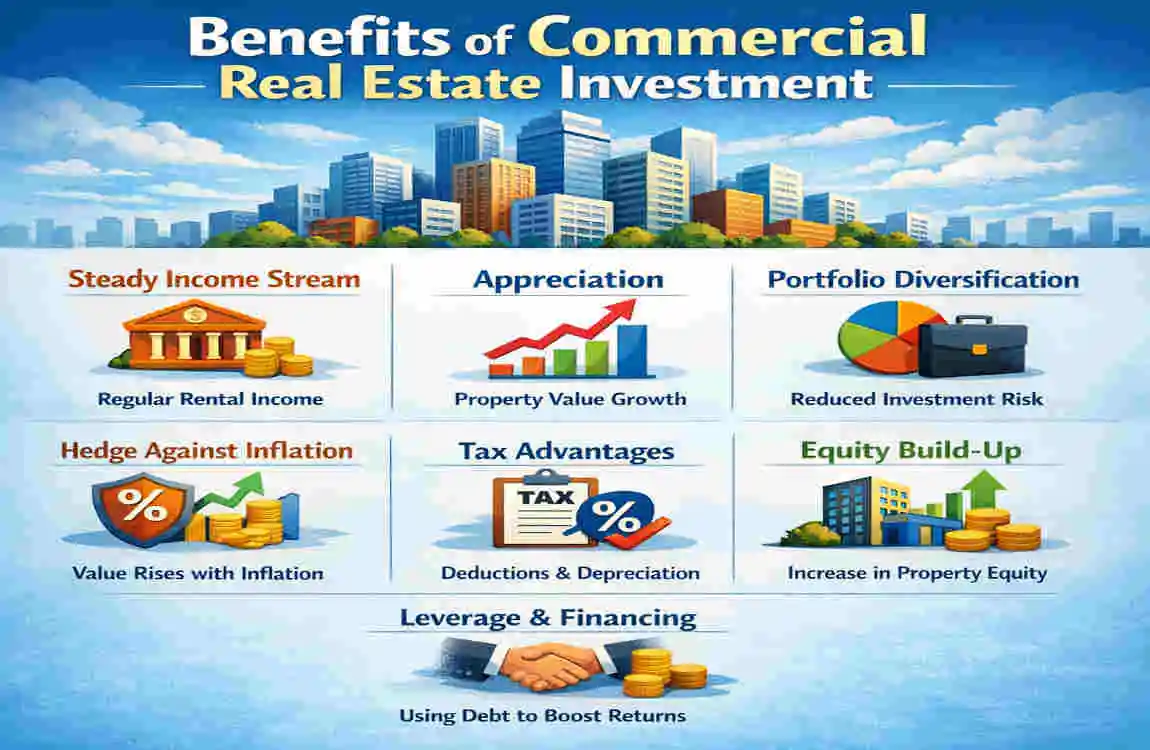
Potential for regular income
One of the biggest reasons people invest in commercial property is the chance to earn rental income. If the building is leased, tenants may pay monthly or long-term rent that supports the investment.
This can create a steady income stream.
Long-term appreciation potential
Property values can increase over time. If the area improves, demand rises, or the building is upgraded, the property may become more valuable.
That growth can lead to stronger returns later.
Portfolio diversification
Diversification means spreading your money across different types of assets. Commercial real estate can help balance a portfolio that already includes stocks or residential property.
This can reduce the risk of relying solely on one investment type.
Possible inflation protection
When prices rise in the economy, rents and property values may also rise. This is one reason many investors view commercial property as a useful tool during inflationary periods.
It does not always move perfectly with inflation, but it can help in some markets.
Longer lease periods
Commercial leases are often longer than residential leases. That means tenants may stay for several years instead of just one.
Longer leases can give owners more predictable income and fewer turnovers.
Property improvement opportunities
Some investors increase value by improving the building. A better layout, updated finishes, stronger management, or better tenant mix can make the property more attractive.
A well-run property often performs better than a neglected one.
Possible tax advantages
There may be tax benefits associated with commercial property ownership, but rules vary widely by location and circumstances. Because of that, it is always smart to speak with a qualified professional before making tax assumptions.
Risks and Challenges for Beginners
Vacancy risk
If a property does not stay leased, income can drop. Vacancy means less rent and more pressure on the owner.
Tenant turnover
Even good tenants may leave when a lease ends. Replacing them takes time and money. During that gap, income may fall.
Market changes
Property values do not always go up. They can fall when the market slows, interest rates rise, or demand weakens.
Maintenance and operating costs
Commercial buildings need repairs, cleaning, insurance, utilities, and management. These costs can be high.
If you ignore them, your expected return may shrink quickly.
Financing and interest-rate risk
Many investors borrow money to buy property. If rates rise, loan costs may rise too. That can reduce profit and make the deal less attractive.
Tenant default and lease issues
If a tenant fails to pay rent or breaks lease terms, the owner may face legal and financial problems. Strong lease review is important.
The need for due diligence
Due diligence means checking the property carefully before buying it. That includes the building condition, lease terms, income records, zoning rules, and market demand.
Skipping this step can lead to costly mistakes.
Why it takes more expertise than residential investing
Commercial deals often involve more paperwork, more math, and more professional help. Beginners can still do well, but they need patience and guidance.
How to Start Commercial Real Estate Investment
Set your goals first.
Before you buy anything, decide what you want.
Do you want monthly income? Long-term growth? A hands-off investment? A property you can improve over time?
Clear goals make the next steps easier.
Know your budget
Commercial real estate often needs more money than residential investing. You should understand how much cash you can commit and how much borrowing you can support.
Build a budget that includes:
- Purchase price
- Closing costs
- Repairs
- Insurance
- Reserves for vacancies
- Management costs
This gives you a more realistic view of the deal.
Research your local market.
A strong property in a weak market can still struggle. Look at local demand, business growth, occupancy trends, and rental rates.
Try to understand which areas are active and which property types are in demand.
Choose the right property type.
Not every beginner should start with the same type of building. Some may prefer a small retail unit. Others may feel more comfortable with a multifamily building or a warehouse.
Choose a type that fits your knowledge, budget, and comfort with risk.
Understand financing options
Commercial property financing can be more complex than home loans. The lender may look closely at your income, credit, the property’s income, and the loan terms.
You may need stronger documentation and a larger down payment.
Work with the right professionals.
A strong team can help you avoid mistakes. You may want to work with:
- Commercial real estate agents
- Property managers
- Accountants
- Attorneys
- Lenders
Each one can help with a different part of the process.
Review the property carefully.
Before making an offer, check:
- Leases
- Financial statements
- Building condition
- Zoning rules
- Tenant quality
- Demand in the area
This step can reveal hidden risks before they become your problem.
How to Evaluate a Commercial Property
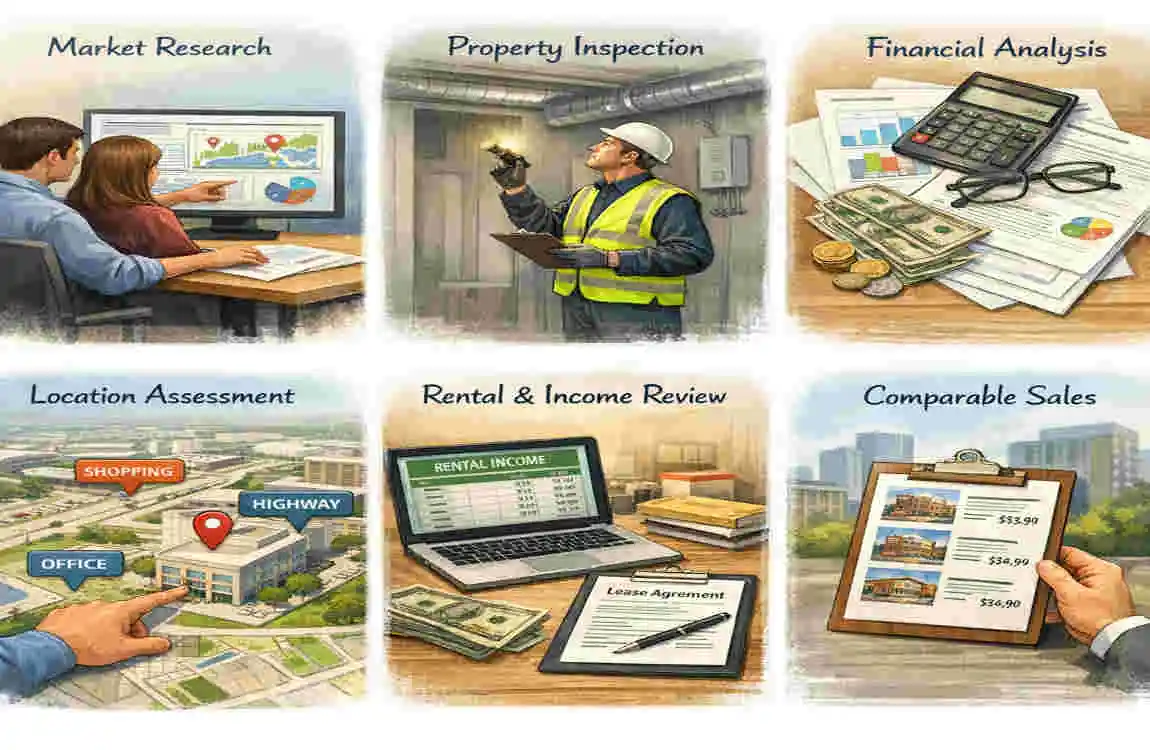
Start with the numbers.
A commercial property should be analysed like a business. The building is not just a place. It is an income-producing asset.
That means you need to study the numbers carefully.
Understand NOI
NOI stands for Net Operating Income. It is one of the most important figures in commercial property analysis.
A simple way to think about it is:
Income from the property – operating expenses = NOI
It helps you see how much the property earns before debt payments and taxes.
Understand cap rate
Cap rate is a quick way to estimate return.
A basic example:
If a building earns $80,000 in NOI and is priced at $1,000,000, the cap rate is 8%.
That helps investors compare one property to another.
Review cash flow
Cash flow shows what is left after expenses and loan payments. Positive cash flow means the property is putting money in your pocket.
Negative cash flow means you are covering the gap from elsewhere.
Look at occupancy and lease strength.
A building with reliable tenants and strong occupancy is often more attractive than one with weak leases and space.
Read the lease terms carefully. Ask how long tenants will stay and what happens when leases end.
Consider the location and future growth.
Location affects almost everything. A property near roads, customers, transport, or business centres may perform better.
Also think about future development. New roads, new businesses, or neighbourhood growth can improve a property’s outlook.
Compare multiple properties
Do not buy the first one you see. Compare several options. That helps you understand price, income, risk, and long-term potential more clearly.
Metric: What It Tells Investors
NOI Property’s operating income
Cap Rate Potential property yield
Occupancy How much space is being used
Cash Flow Money remaining after expenses
ROI Overall investment performance
FAQs About Commercial Real Estate Investment
What is commercial real estate investment?
It is the process of buying or funding property used for business purposes. Investors may earn money from rent, appreciation, or both.
Is commercial real estate investment good for beginners?
It can be, but it is not always simple. Beginners should research carefully, understand the numbers, and get professional advice before making a purchase.
How much money do you need to invest in commercial real estate?
It depends on the property type, location, financing method, and investment structure. Some direct purchases require a large amount of capital, while indirect options may need less.
What is the most profitable commercial real estate?
There is no single answer. Profitability depends on location, demand, purchase price, expenses, lease terms, and financing.
How do you make money from commercial real estate?
You may earn income from rental income, property value growth, improved management, and improvements that increase the property’s income potential.
What is a good cap rate for commercial real estate?
There is no universal good cap rate. The right number depends on the property type, market, risk level, and local demand.
What are the biggest risks of commercial real estate investment?
The main risks include vacancy, tenant problems, market changes, financing costs, and maintenance expenses.
| Key Area | Simple Explanation |
|---|---|
| What Is It? | Investing in properties used for business, such as offices, retail stores, warehouses, and apartments. |
| Common Property Types | Office buildings, shopping centers, industrial properties, multifamily buildings, and hotels. |
| How Investors Earn | Mainly through rental income, property appreciation, and potential tax benefits. |
| Initial Investment | Usually requires more capital than residential real estate, including a down payment and closing costs. |
| Financing | Investors may use commercial mortgages, private financing, partnerships, or other investment structures. |
